When an historical event is passing into legend, it helps to have a poem written about it.
Thus we have Thomas Buchanan Read’s “Sheridan’s Ride,” based on the battle of Cedar Creek, Va., fought on Oct. 19, 1864. “Up from the south at break of day/Bringing to Winchester fresh dismay,” the poem begins. The “fresh dismay,” to the Northern versifier, was Jubal Early’s surprise dawn attack on Philip Sheridan’s forces camped at Cedar Creek, south of Winchester. The Confederates overwhelmed and routed the Federals, then Early called off the pursuit around 10 a.m.
Sheridan was twenty miles away at Winchester during the battle. He could hear the sound of distant fighting: “And louder yet into Winchester rolled/The roar of that red sea uncontrolled/ Making the blood of the listener cold.” “Little Phil”—he was all of 5' 5" tall—saddled up Rienzi, his black charger, and started riding toward his embattled army.
At first he saw groups of blueclad stragglers, then retreating masses. Faced with his panicked troops, he determined to rally them for a counterattack. “What was done? What to do? A glance told him both,” as Read’s verse puts it. The rattled retreaters took heart and halted. Sheridan then formed them for a counterstroke, with the general at one point riding the entire length of his cheering ranks: “He dashed down the line, ‘mid a storm of huzzas.” Finally, around 4 p.m., Union infantry and cavalry attacked Early’s left flank and began rolling it up. Now it was the Rebels’ turn to run, which they did. Pursuing Union horsemen scooped up a thousand prisoners, two dozen pieces of artillery, small arms, and wagons. Sheridan’s victory was complete. “Hurrah! hurrah for Sheridan!/Hurrah! hurrah for horse and man!” Read exclaims, closing with paeans for both Sheridan and Rienzi, “the steed that saved the day.”
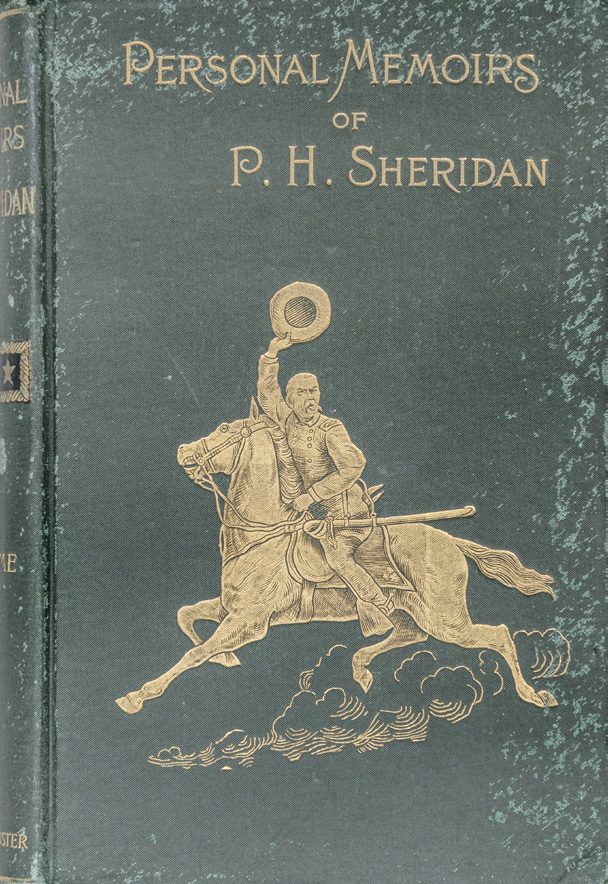
The general died in August 1888, having just finished his reminiscences, which were published by Charles Webster in two volumes later that year. Sheridan was proud of his war record, especially his dramatic triumph at Cedar Creek. In his Personal Memoirs he noted that General Grant ordered a hundred-gun salute in celebration of the victory, and that President Lincoln sent him a special letter of thanks (reproduced in vol. II, p. 91).1
• Lecturer • Author • Course Instructor
But in his description of the battle itself, and his ride to rally his troops, he was rather laconic. Not so his biographers. Rushing into print the very year of the general’s death was Frank A. Burr and Richard J. Hinton’s “Little Phil” and his Troopers. The Life of Gen. Philip H. Sheridan. The Romance and Reality: How an Humble Lad Reached the Head of an Army. In it Sheridan’s ride from Winchester is, of course, dramatically related. “Who, knowing the quality of the man,” they chirp, “cannot picture the restless rider urging his horse to his utmost speed to reach the field where the fate of his army was still pending in the hazard of war.” Burr and Hinton not only print Read’s “Sheridan’s Ride” in full, they tell the story of its first public reading at a Cincinnati opera house Nov. 1, 1864—just a week and a half after the event. The reader was one James E. Murdoch, friend of the poet, who recalled that the recited verses brought down the house (“cheer after cheer went up from the great concourse that shook the building to its very foundation”).2
Another early biographer, however, tried to tamp the whole thing down. Henry E. Davies, writing in 1895, reminded readers how “historic facts often destroy the romance and splendor with which a poetic imagination can invest the realities of actual life.” True, Sheridan’s troops had been routed; the general rode forth and rallied them; the Federals charged and won the day. Yet Davies sought to dispel the rosy glamour that had settled upon the ride, imparted at least partly by Read’s poem. “Upon General Sheridan’s authority,” the biographer explains, “it appears that the thrilling story of Sheridan’s Ride is a poetic conception, with as little foundation of truth as the heroic figure of Barbara Frietchie.”3
A generation later, Joseph Hergesheimer cast some scholarly detachment on the ride in his Sheridan (1931) by holding the general’s account up to other sources. No one, however, could disagree with the conclusion: “when General Sheridan did arrive upon the battle-field at Cedar Creek, an enormously improved spirit and steadiness instantly pervaded the Union army.”4
Richard O’Connor, biographer of George Thomas (1948) and John B. Hood (1949), turned his attention in 1953 to Sheridan (and his ride). “Sheridan’s 14mile ride to the battlefield at Cedar Creek became the subject of heated controversy almost as soon as the clatter of the hoofs died down on the flint-hard Valley Pike,” he asserts.
It was glorified by the poem of T. Buchanan Read (which made the general’s horse Rienzi almost as famous as his rider), it was given a muck-raking by historians of a more skeptical era, it was argued in the newspapers and at veterans’ reunions for years afterward. There were those who said it was only a curious canter, and there were others who contended it was the maddest gallop since the headless rider pursued Ichabod Crane.
O’Connor concludes simply, “it was good hard ride, everything considered.”5
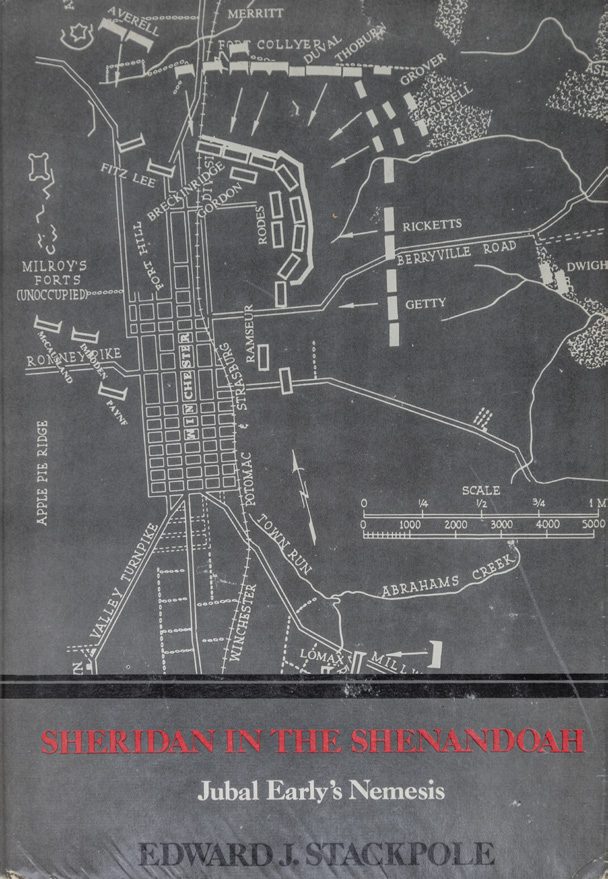
It seems that Thomas Buchanan Read’s poem casts its shadow on virtually all narratives of Cedar Creek. An example comes from Edward J. Stackpole’s Sheridan in the Shenandoah (1961). The author of books on Gettysburg (1956) and other eastern theater campaigns, Stackpole took upon himself the estimation of how fast Little Phil rode from Winchester to the battlefield. “A simple calculation on the distance covered, approximately 12 miles from Mill Creek to the position where he came up with
his disorganized army 1 ½ miles north of Middletown,” the author reasons, “proves rather conclusively that he did not proceed at an extended gallop, as the poet would have us believe.” Stackpole, as you see, did not name “the poet.” At this point in the literature, he really didn’t need to.6
In the past three decades, no fewer than five works on Sheridan have appeared. Paul Andrew Hutton, Phil Sheridan and His Army (1985) concerns the general’s campaigns against the Indians after the Civil War, summarizing his life before 1867 in fewer than thirty pages.7 Roy Morris Jr. is known as editor of America’s Civil War magazine and author of books on subjects as varied as Walt Whitman (2000) and the election of 1876 (2003). In his biography of Sheridan (1992), he seems to have some fun with Read’s poem.
In the usual progress of worldly fame, the sublime soon gave way to the ridiculous. A minor poet named Thomas Buchanan Read, at the urging of retired actor James E. Murdock, who had visited Sheridan’s campaign a year earlier at Chattanooga to claim his son’s body, unburdened himself of a
sixty-three line poem, written in galloping octometer, on the subject of “Sheridan’s Ride.” The poem was considerably short of a masterpiece, the best lines going to the horse Rienzi, but as a piece of Republican campaign rhetoric it was unexcelled. Debuted by Murdock at Cincinnati’s Pike Opera Hall on Nov. 1, 1864, “Sheridan’s Ride” took the North by storm and made its bemused subject even more of a household name. When Lincoln swamped McClellan in the presidential election a week later, many observers credited Read’s poem— as much as its inspiration’s achievements on the battlefield—with swelling the rout. Sheridan himself, perhaps ironically, renamed Rienzi “Winchester” in honor of the poem’s famous refrain: “Winchester, twenty miles away.”
Morris suggests that had it not been for Read’s poem, Sheridan’s ride would have been consigned, well, to the dustbin of history. “[G]enerations of schoolchildren as yet unborn would stand before blackboards in northern cities reciting Read’s anthropomorphic epic.” Indeed, the poem won “a place in every elementary school primer for the next fifty years.”8
Eric Wittenberg, historian of Union cavalry, stands apart from the rest of the literature in what Jeffry D. Wert has called “a scathing indictment of Sheridan’s record,” his Little Phil: A Reassessment of the Civil War Leadership of Gen. Philip H. Sheridan (2002). Chapter titles alone indicate the author’s caustic perspective: “Sheridan as Cavalry Corps Commander: Mediocrity Reigns;” “Little Phil in the Shenandoah Valley: A Victorious Campaign Bereft of Decision;” and “Sheridan’s Disobedience of Orders.” As balance to all of this—you guessed it—Wittenberg’s opening pages reprint the complete text of Read’s “Sheridan’s Ride.”9
David Coffey, in Sheridan’s Lieutenants (2005), makes at least passing reference to Read’s poem.10 So does Joseph Wheelan
Antietam Battlefield Guides
The 1862 Maryland Campaign 2-8 hour tours or customized to your interest Tours of Antietam Harpers Ferry South Mountain Shepherdstown
in his biography of Sheridan (2012), adding that Read’s poem was “widely reprinted in newspapers across the North.”11
You get the idea. I happen to be a fan of Western films, including John Ford’s The Man Who Shot Liberty Valance (1962). One of its characters famously declares, “When the legend becomes fact, print the legend.” In the case of Sheridan at Cedar Creek, biographers and military historians have detailed the memorable events of Oct. 19, 1864. But one may argue that it was Thomas Buchanan Read’s famous poem that allowed Sheridan’s ride to pass from fact into legend.
1. Personal Memoirs of P. H.
2. Frank A. Burr and Richard
3. Henry A. Davies, Gener
4. Joseph Hergesheimer, Sher
5. Richard O’Connor, Sheridan
6. Edward J. Stackpole, Sher
7. Paul Andrew Hutton, Phil
8. Roy Morris Jr., Sheridan:
9. Eric J. Wittenberg, Little Sheridan. General United States Army, 2 vols. (New York: Charles L. Webster & Co., 1888), II, 74-92.
J. Hinton, “Little Phil” and his Troopers. The Life of Gen. Philip H. Sheridan. Its Romance and Reality: How an Humble Lad Reached the Head of an Army (Providence R.I.: J.A. and R.A. Read, 1888), 233-36.
al Sheridan (New York: D. Appleton and Co., 1895), 182-87.
idan: A Military Narrative (Boston: Houghton Mifflin, 1931), 250-54.
the Inevitable (Indianapolis: Bobbs-Merrill Co., 1953), 226.
idan in the Valley: Jubal Early’s Nemesis (Harrisburg Penn.: Stackpole Co., 1961), 323.
Sheridan and His Army (Lincoln: University of Nebraska Press, 1985), 2-27.
The Life and Wars of General Phil Sheridan (New York: Crown Publishers, 1992), 220.
11. Joseph Wheelan, Terrible
regular contributor to Civil War News and is the Book Review Editor.
Task: The Atlanta Campaign from Dalton through Kennesaw Mountain to the Chattahoochee River May 5-July 18, 1864, was published as part of Savas Beatie’s Emerging Civil War paperback series.
The Fighting They Want: The Atlanta Campaign From Peachtree Creek To The City’s Surrender, July 18-September 2, 1864, was published this Spring.
Sheridan’s Coffey, Lieutenants:Phil Sheridan, His Generals, and the Final Year of the Civil War (Lanham, Md.: Rowman and Littlefield, 2005), 94.
Swift Sword: The Life of General Philip H. Sheridan (New York: Da Capo Press, 2012),
Steve Davis of Atlanta is a
His book, A Long and Bloody
The companion volume, All
New Titles from Stephen Davis
The Atlanta Campaign from Dalton through Kennesaw Mountain to the Chattahoochee River May 5–July 18, 1864 Davis’ narrative history of the Atlanta Campaign is divided into two paperbacks from Savas Beatie’s Emerging Civil War Series. Volume One, A Long and Bloody Task, carries Sherman’s forces from Dalton in northwest Georgia to the Chattahoochee River. There the Confederate government was forced to relieve its army commander, Joseph E. Johnston, and replace him with Gen. John B. Hood.
All the Fighting They Want
Small Talk
1. The first Confederate major
2. “General Grant is a great
3. Jefferson Davis had six sec
With the Yankee army five miles outside of Atlanta, Hood promised not to give up with city without a fight— which is all President Jefferson Davis asked. Davis’ companion volume, All the Fighting They Want, describes Hood’s efforts to defend Atlanta. Its fall in early September 1864 was a mortal blow to Confederate hopes for independence and a big boost to Lincoln’s hopes for presidential reelection.
general to die in the war was not from battle causes—just old age. He was in fact the South’s oldest general, born in 1790 and dying on July 15, 1862. While in the old army he surrendered all U.S. property in Texas to secessionists in February 1861. Can you name him?
general. I know him well. He stood by me when I was crazy and I stood by him when he was drunk; and now, sir, we stand by each other always.” Who is alleged have said this?
retaries of war; Lincoln had two. Who was Lincoln’s first war secretary?
4. Alexander Stephens, Con
5. Who was the Maryland phy
7. On May 10, 1864, his infantry
8. What was a “shinplaster”?
9. On Nov. 29, 1863, outside
10. “Old Missus marry Will de
Want To Advertise In Civil War News?
federate Vice President, was imprisoned after the war for five months at a U.S. fort in Boston harbor. Which one? sician who set John Wilkes Booth’s leg on April 15, 1865, was arrested, convicted for complicity in the assassination plot, and served four years of a life sentence? Union general KIA/MW died July 3, 1863, after being ordered to lead his cavalry brigade in a charge against Confederate infantry. Who?
attack, a “lightning foray,” as Gordon Rhea terms it, broke Lee’s line at the Mule Shoe salient at Spotsylvania, and led to Grant’s decision for a bigger attack on May 12. Name the officer.
a) a military jail or brig; b) a soldier’s ration of hard baked bread; c) a monetary note of small denomination; or d) a moist poultice for wound treatment.
Knoxville, Tenn., Longstreet’s Confederates were repulsed attacking a Union fort, hindered by telegraph wire strung among tree stumps, and blocked by a deep wide moat dug outside the parapet. Name the fort. weaber/Willum was a gay deceaber/His face was sharp as a butcher’s cleaber/But dat did not seem to greab er.” These lines are from a lesser known stanza of a song popular in the wartime South. Which song?
Reviewed by Thomas J. Ryan
Maj. Gen. George G. Meade and his Army of the Potomac were unable to exploit the prospect of further damaging the Army of Northern Virginia near Williamsport, Md., following Gen. Robert E. Lee’s defeat at Gettysburg on July 1 to 3, 1863. Other opportunities, however, presented themselves during a 17-day retrograde movement south toward the Rappahannock River.
Jeffrey Wm Hunt addresses events that took place beginning July 14, after Lee’s forces crossed the Potomac, until July 31 when both armies arrived back at the point from which the campaign began. The author examines the strategic and tactical maneuvering for advantage on the part of Meade and Lee in this groundbreaking study of a segment of the Gettysburg campaign that has not received the attention it deserves.
Hunt relates that another major battle could have been in the offing, if Meade had orchestrated his forces and operated in a timely manner. Yet, in a reprise of the Gettysburg aftermath, Meade fretted about what Lee would do and the potential consequences, essentially relinquishing the
Publishers: Please send your book(s) for review to:
initiative to his opponent.
Meade’s hesitancy to make decisions in crucial situations demonstrated the difficulty of his leap from corps to army command, and how clarity of vision dims and self-motivation dissipates as responsibility increases. The odds of success lessened further for Meade given his audacious and more experienced opponent.
Meade placed himself in a deeper hole from a command point of view after Gettysburg by choosing three generals with limited credentials to replace the hard-charging Maj. Gens. John Reynolds, Winfield Scott Hancock, and Daniel Sickles—all three casualties at Gettysburg. In particular, selection of Maj. Gen. William French for Third Corps command would prove to be costly.
Hunt summarizes Lee’s expedition into the North beginning in early June, his defeat at Gettysburg, and the aftermath of the battle in which Lee’s army escaped damaged but still intact. The author describes how Meade’s delay in crossing the Potomac in pursuit allowed Lee time to rest his fatigued troops before marching in the direction of safer ground on the south side of the Rappahannock River. Although not specifically addressed, Meade’s indecision about employing pontoon bridges to cross the Potomac was a factor in the delay.
The author explains that, as happened after Gettysburg, the Union cavalry engaged in combat with the enemy, while the infantry played catch-up given Lee’s head start. Brig. Gen. David Gregg’s cavalry division initially carried the heaviest load, and suffered substantial casualties. Although Brig. Gen. Benjamin Kelley forded the Potomac above Williamsport on July 15 with nearly 6,000 infantry and cavalry of his West Virginia command intending to inflict damage on the Rebels, his efforts came to naught and his troops narrowly avoided capture or annihilation thanks to timely information provided by a local citizen.
This segment of the campaign focused on gaining control of the gaps in the Blue Ridge Mountains separating the two armies. The Rebels managed to maintain control of Chester Gap, allowing Lt. Gen. James Longstreet’s corps to move through toward the Rappahannock River. A potential confrontation at Manassas Gap or Front Royal occurred when Meade directed French’s Third Corps to intercept and attack Lee’s forces that were making their way south up the Shenandoah Valley. Mirroring his commander’s approach, “a very much confused French” hesitated and mismanaged his assignment leading to frustration and failure.
Yet the ultimate responsibility for the lack of success of the Union army during this period was Meade’s, for inherent caution and defensive-mindedness in dealing with combat situations. Mimicking Generals Joseph Hooker and George B. McClellan, his predecessors, Meade attributed to Lee and his army a strength that was non-existent. In contrast, Lee was determined to accomplish specific objectives, and outmaneuvered his opponent. The Confederate army desired to avoid a confrontation and find refuge south of Fredericksburg, while Meade maintained the unrealistic concern that Lee may go back on the offensive.
Having done extensive research, Jeffrey Wm Hunt describes this battle of wits between Meade and Lee with assurance. Included are maps, a bibliography and an index. Missing, however, are eight reports that the Army of the Potomac’s intelligence staff under Col. George H. Sharpe prepared for chief of staff Maj. Gen. Andrew A. Humphreys from July 19 through July 29. Inclusion of these reports and another intelligence-related document (available at the National Archives) would have enhanced the narrative.
Meade and Lee After Gettysburg is a welcome study that demonstrates the final encounters of the Gettysburg campaign occurred at the end of July 1863, rather than the commonly accepted date of July 14th. During this time, Lee achieved the goal of preserving his army to fight another day, while Meade experienced disappointment similar to the immediate post-Gettysburg period when caution became the watchword of his command style and performance.
Thomas J. Ryan is the author of Spies, Scouts, and Secrets in the Gettysburg Campaign. His latest book, with co-author Richard R. Schaus, is Eleven Fateful Days in July 1863: Meade Tracks Lee’s Army after Gettysburg (due out in 2018).
He writes a weekly “Civil War Profiles” column for the Coastal Point, an Ocean View, Delaware newspaper.
Interesting Account of Union Service in the Far South Western Frontier During the Civil War
Ordered West: The Civil War Exploits of Charles A. Curtis. Edited by Alan D. Gaff and Donald H. Gaff. Photos, maps, footnotes, bibliography, index, 575 pp., 2017, University of North Texas Press, www.untpress.unt.edu, $39.95 hardcover.
Reviewed by Robert L. Durham
Charles Curtis began his service in the Civil War at the Battle of First Bull Run, where he received a crippling wound in the knee. Unable to march, instead of returning to Maine and spending the remainder of the war comfortably at home, he enlisted in the 5th United States Infantry. The 5th U.S. was stationed on the American frontier, in the territories of New Mexico and Arizona.
Through the pages of Curtis’ journal, we can experience his trip by stagecoach over the Santa Fe Trail to reach his duty station at Fort Craig, N.M.. The journey was not uneventful and neither were the rest of Curtis’ exploits. During his service, Charles Curtis commanded several forts and constructed Fort Whipple, Ariz. He led many expeditions against
November 11 & 12, 2017
February 3 & 4, 2018
the Navajo and Apache, in one of which, while attempting to escape from an Apache ambush, he was wounded in the side by an arrow. Curtis imparts much information on Indian tribes that he encountered.
Charles had a good relationship with most of his fellow officers and with the regular infantrymen under his command. Everyone serving there had to endure inevitable practical jokes and Curtis was as often a target of these pranks as he was the perpetrator. His friends often took advantage of his fear of snakes, which were abundant.
There is also much detail on the towns he passed through. Of a naturally curious bent, Charles explored every town and Indian village he encountered, chronicling tales of the people and their customs, some of them a little curious to modern readers.
Curtis’ memoirs present many harrowing and amusing accounts of his life on the frontier. He met many noteworthy frontier characters, Mexican ranchers and mountain men (Kit Carson among others). The two Gaffs do a great job in the footnotes; I found it hard to believe the details they found on so many individuals and locations. There are very few people mentioned in the journal on which they were not able to find information.
While not a Civil War book per se this would be an interesting volume to add to your bookshelf. I enjoyed it thoroughly and am sure most readers would appreciate Curtis’ frontier encounters.
Robert L. Durham of Centerville, Ohio, is a longtime contributor to CWN. His articles on the battles of Richmond, Ky. and Raymond, Ms. appeared in our June-July issues.