In my column last March I wrote about The Bell Irvin Wiley Reader, a collection of the great Civil War historian’s writings assembled by Hill Jordan, “Hank” Segars, and “Bud” Robertson (LSU Press, 2001).
The compilers include a fine bibliography of Wiley’s works. It lists thirty-two books which the professor wrote or edited, and another dozen and a half for which he wrote forewords and introductions. A number of the titles which he edited or introduced were published by the University of Georgia Press and a few other academic houses, such as the Confederate letters of Sgt. John W. Hagan (Georgia, 1954) and of Sgt. Edwin H. Fay (University of Texas, 1958).
By my count, Dr. Wiley assisted in more Civil War books— fourteen in all—printed by McCowat-Mercer Press of Jackson, Tenn., than any other publisher.
Yes, McCowat-Mercer. If you haven’t heard of it, don’t worry. Founded in 1938, it’s still in Jackson, today manufacturing cardboard boxes.
Bell Wiley put McCowat-Mercer on today’s Civil War bookshelf, beginning in the 1950s. To wit:
CONFEDERATE JOURNALS OR MEMOIRS EDITED BY WILEY, PUBLISHED BY McCOWAT-MERCER PRESS •
Wiley’s diligent research is evident throughout his McCowat-Mercer series. In his Introduction to William W. Heartsill’s Fourteen Hundred and 91 Days in the Confederate Army, he describes the veteran’s self-printing of one hundred copies of the Co. Aytch Maury Grays First Tennessee Regiment or A Side Show of the Big Show. By Sam R. Watkins (1952) Fourteen Hundred and 91 Days in the Confederate Army. By W.W. Heartsill (1954) Reminiscences of Big I. By William Nathaniel Wood (1956) Kentucky Cavaliers in Dixie: Reminiscences of a Confederate Cavalryman. By George Dallas Mosgrove (1957) Recollections of a Confederate Staff Officer. By G. Moxley Sorrel (1958) A Southern Woman’s Story: Life in Confederate Richmond. By Phoebe Yates Pember (1959) Four Years on the Firing Line. By James Cooper
• Lecturer • Author • Course Instructor
journal a decade after the war; his location of only thirteen surviving copies of the book at the Library of Congress and elsewhere; and his comparison of Heartsill’s handwritten manuscript (at the University of Texas) with the printed version. Wiley even added a note to his Introduction, that after it had been typeset he had found another manuscript version of “1491 Days” in the hands of a private dealer.
The editorial staff in Jackson obviously appreciated Dr. Wiley’s labors. Gathering material for publication in The Wiley Reader, Hill Jordan found in the professor’s papers at Emory his typescript Introduction to Heartsill’s book. I compared Wiley’s typescript with McCowat-Mercer’s printed text, and found nary a change.
Wiley’s style of editing was deft, learned, and conscientious. James Cooper Nisbet’s Four Years on the Firing Line is the intelligent memoir of a Confederate officer (Col., 66th Georgia Inf.), published in a small edition in 1914. It was long out of print when McCowat-Mercer republished it in 1963, with Wiley as editor. “Considerable revising has been done” to Nisbet’s volume, he explained in his Introduction, to “sharpen the focus on Nisbet’s war experience.” The author was not at Chickamauga; Wiley omitted that section. He did the same with passages which the veteran wrote from secondary sources, not firsthand. When Nisbet quoted from published sources, Wiley identified them and even noted where he had misquoted them.
Almost all McCowat-Mercer’s reprints are of Confederates’ writings. Wiley wrote the Foreword for five of them, edited by other scholars: •
In addition, the printing house Gunner with Stonewall: Reminiscences of William Thomas Poague. Ed. by Monroe F. Cockrell (1957) A Life for the Confederacy: As Recorded in the Pocket Diaries of Pvt. of Robert A. Moore Co. G 17th Mississippi Regiment. Ed. by James W. Silver (1959) Cleburne and His Command by Capt. Irving A. Buck. Ed. by Thomas Robson Hay (1959) Whipt ‘em Everytime: The Diary of Bartlett Yancey Malone Co. H 6th N. C. Regiment. Ed. by William Whatley Pierson, Jr. (1960) One of Jackson’s Foot Cavalry by John H. Worsham. Ed. by James I. Robertson, Jr. (1964) in Jackson released As They Saw Forrest: Some Recollections and Comments of Contemporaries, edited by Robert Selph Henry (1956). In his biography of General Forrest (1944), Henry had found a lot of writings about the famed Confederate cavalryman which he wanted to see published. Henry was friends with Seale Johnson, the head of McCowat-Mercer (who called the biographer “Booty” Henry). By that time, Wiley was working with Johnson and his press, and so was drawn in to write a Foreword. Years later, Johnson’s printing house re-released Henry’s esteemed biography, “First With the Most” Forrest in a 1969 edition, for which Wiley also contributed a Foreword.
It is evident that Wiley enjoyed friendship with Seale Johnson, a fellow West Tennessean and, like Wiley, a bibliophile. I recently attended a Civil War conference with Dr. Robertson, who studied under the professor in the 1950’s. I asked Bud if he knew how Wiley had become connected with McCowat-Mercer. He didn’t know.
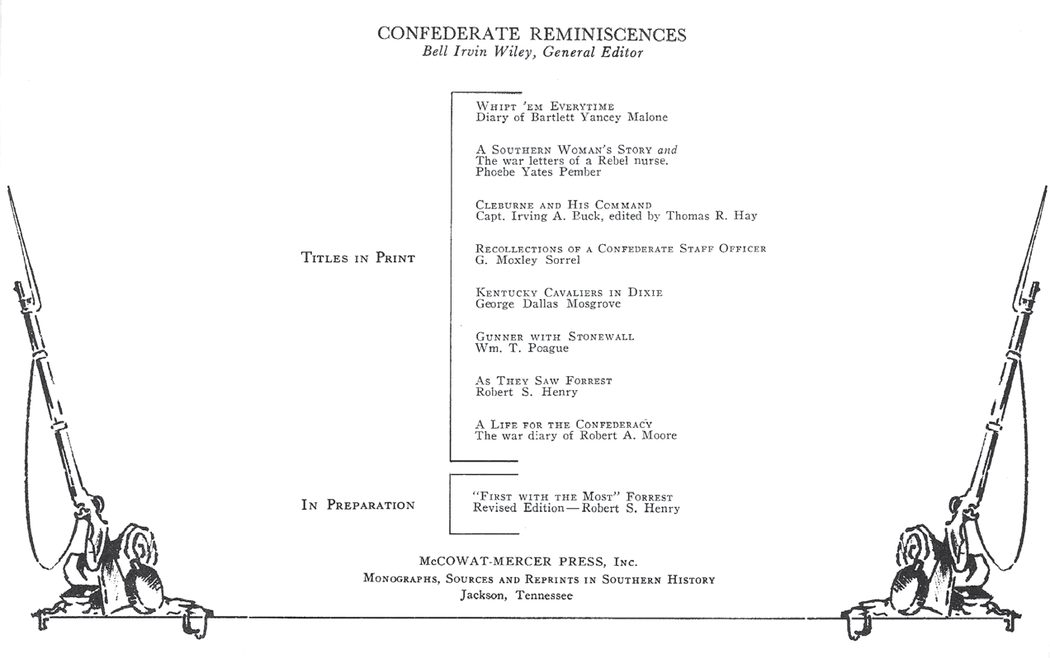
But their work together is highly esteemed by today’s Confederate book collectors. On the title page of Henry’s As They Saw Forrest is a note that this is “No. 3 of a Series/ Monographs, Sources and Reprints in Southern History, Bell Irvin Wiley, Editor.” Half of the other Wiley/McCowat volumes also carry this series title. In my personal library I am privileged to own ten of these fourteen Inserted with the Christmas card, Johnson and Wiley listed books published by McCowat-Mercer, 1956-60, in Wiley’s series as editor.
works, and they are among my most valued treasures. Inside my copy of As They Saw Forrest I see a special page, “Riders with Old Bedford Edition,” autographed for the Civil War Book Club by Robert S. Henry. Back then, paper jackets were actually printed with books’ retail prices; my Forrest originally went for a full $5.00 (imagine that!).
I was in Dover, Tenn., a few Jackson, Tenn.”
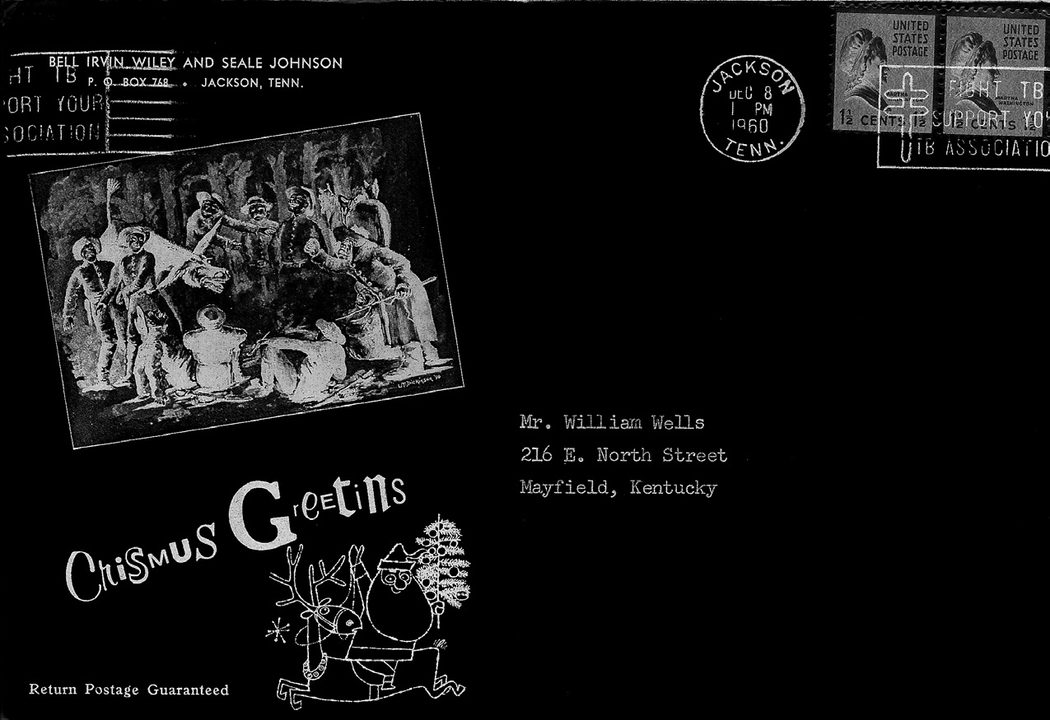
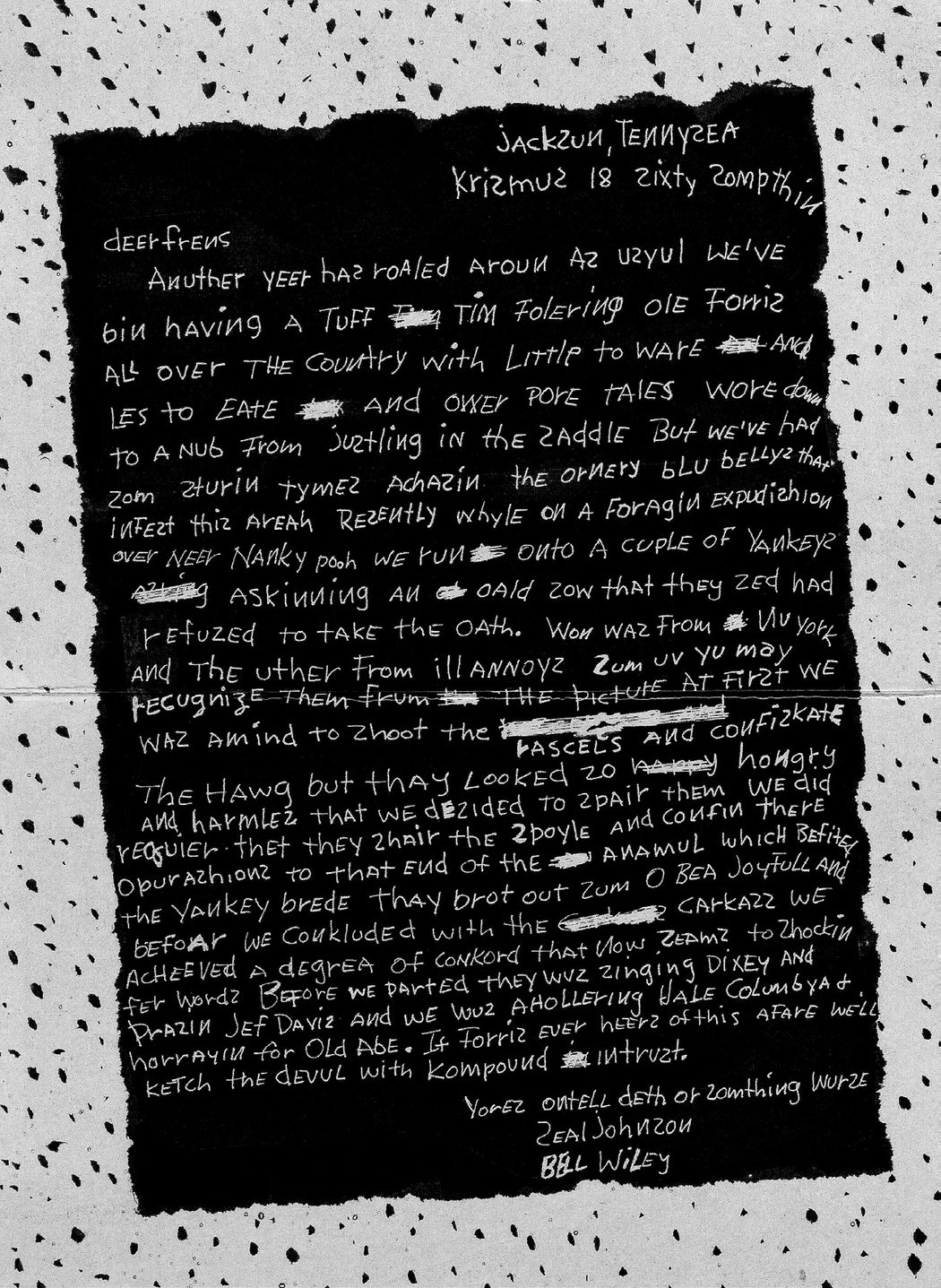
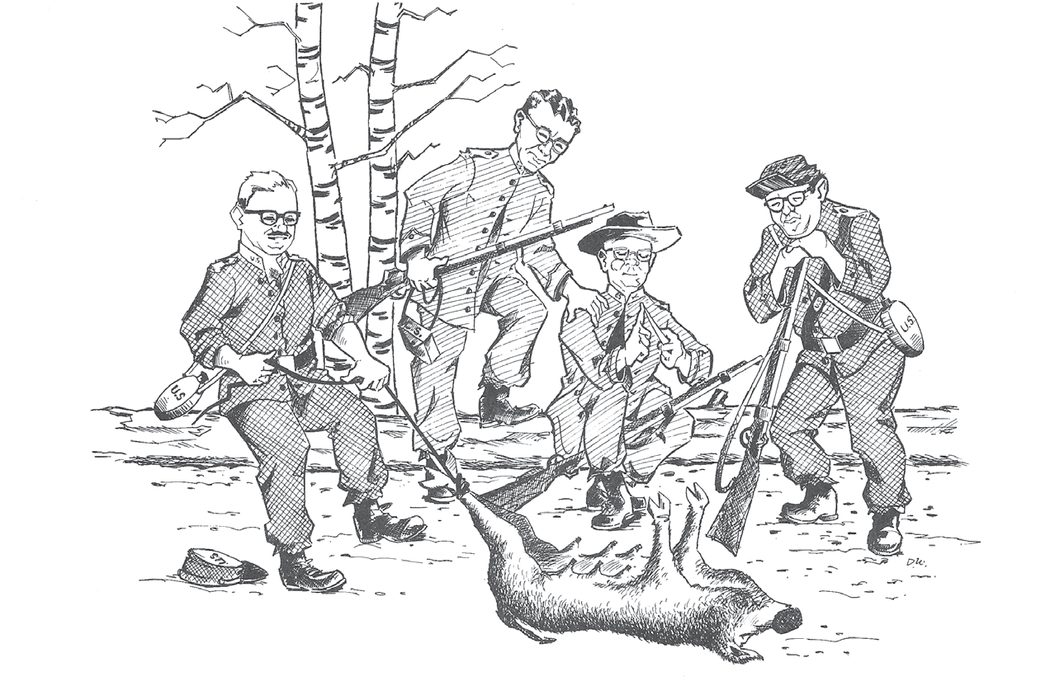
It’s obvious that Bell and Seale shared a great sense of humor. The card’s drawing shows them in Confederate uniforms about to skin a pig. Inside, in semi-literate, misspelled printing, they extended their seasonal wishes: “deer frens—another yeer has roaled aroun….We’ve bin having a tuff tim folering old Forris,” they explain, “but we’ve had some sturin tymes achasin the ornery blu bellys that infest this areah.” The senders signed their card, “Yores ontell deth or something wurse, Seal Johnson Bell Wiley.”
What an uproarious time Bell and Seale must have had, producing their “Crismus Greetins”! Of particular interest, as Mr. Wells showed me, was an included listing of the “Confederate Reminiscences” for which Wiley was serving as McCowat-Mercer’s General Editor. Eight titles were already in print (named above); Henry’s” “First With the Most” Forrest was “in preparation.”
Evidently Wiley and Johnson sent Christmas cards another year or two after that, ca. 1961-62, to friends of the Press; Hill Jordan found them in the Wiley Papers at Emory. One is headed, “In Camp neer Jaxsun, Tinysea Crismus 186—(bin fiting Yankees so long we’ve lost track uv the yeer).” Here, an artist has drawn the two as Confederate soldiers roasting a chicken with a corked jug nearby. They explain the scene: “we aire indulgin ourselves in some Rock mea to sleap muther, otherwyse known as O Bea Joyfull, thoughtfully provided by the Yankeys. The foul is a Union sympathyzer that we had to kill in self defense when hit strutted into our camp and threatened to do us hurt at the Crismus time. That’ll larn him.”
Bell Wiley taught me many things when I was a student working with him at Emory in the late 60’s. Having now seen his and Seale Johnson’s “Pusonal Greetins at the Yuletide from Two old Cotton-Pickin’ Rebels,” I can now add another lesson: one can be the world’s leading authority on Civil War soldiers, but don’t take yourself too seriously.
Steve Davis of Atlanta is a regular contributor to Civil War News and is the Book Review Editor.
His book, A Long and Bloody Task: The Atlanta Campaign from Dalton through Kennesaw Mountain to the Chattahoochee River May 5-July 18, 1864, was published as part of Savas Beatie’s Emerging Civil War paperback series.
The companion volume, All The Fighting They Want: The Atlanta Campaign From Peachtree Creek To The City’s Surrender, July 18-September 2, 1864, was published this Spring.
Small Talk
1. He arguably fired the first shot
2. This Union major general
3. First Union general to die
4. And who was the first Confed5. At Appomattox, in Wilmer Mc
6. Confederate commander at of the Civil War, and the last. This Virginia agricultural reformer and ardent Southern nationalist pulled the lanyard of the first cannon fired from the “Iron Battery” against Fort Sumter on April 12, 1861. In June 1865, after declaring his “hatred to Yankee rule,” he committed suicide. Name him. is possibly best known for having written after the war an historical novel that was made into a famous Hollywood movie Charlton Heston. Who?
on the battlefield in the war was…?
erate general killed in battle? Lean’s parlor, General Lee saw among Grant’s staff officers one whose appearance caused him allegedly to remark, “I am glad to see one real American here.” Who was the officer?
Ball’s Bluff, Oct. 21, 1861, was fond of whiskey and had an aide follow him with his “barrelita” full of it. Name him.
Band members are: Elaine Winters – fiddle Daniel Rothwell – banjo Rob Pearcy – guitar and dulcimer
7. Another bibulous officer: on
9. In October 1860 eleven-year-
10. In 1954 Van Heflin starred in
July 30, 1864, his division led the Union charge into the crater. While his troops were being cut up in their attack, this brigadier stayed behind in a bombproof, drinking rum. Who was he?
(cont’d): this Kentucky-born Confederate major general was said to have been intoxicated at Mill Springs in January 1862. Three months later, General Hardee had him arrested for drunkenness and court-martialed; he resigned that October. Who? old Grace Bedell recommended to a prominent American that he grow a beard, “for your face is so thin” and “all the ladies like whiskers.” Who grew the beard?
a Hollywood film based on the Confederate foray from Canada into St. Albans, Vt., on Oct. 19, 1864. Can you name the movie?
Reviewed by Brian Matthew Jordan
After a sluggish stretch, biography is once again the stock in trade of American Civil War historians. In the last two years, we’ve been treated to major new accounts of the lives of William Tecumseh Sherman (by James Lee McDonough), Montgomery C. Meigs (by Robert O’Harrow), Edwin McMasters Stanton (by William Marvel), Julia Ward Howe (by Elaine Showalter), Braxton Bragg (from the prolific pen of Earl J. Hess), George Armstrong Custer (by Pulitzer Prize-winning author T.J. Stiles), and “Stonewall” Jackson (by S.C. Gwynne).
Nor, it seems, will this renewed industriousness fade anytime soon, with new treatments of Robert E. Lee (by Allen C. Guelzo), Benjamin Butler (by Elizabeth Leonard), George G. Meade (by Christopher Stowe), and Frederick Douglass (by David Blight) on the way. Even the period’s lesser known figures are at long last getting their due treatment, as evidenced by Elizabeth R. Varon’s forthcoming work on the African-American veteran and historian Joseph T. Wilson, and James Marten’s upcoming book on “Oliver Optic,” who penned popular tales of the war for children in the late nineteenth century.
What does this biographical bumper crop mean within the larger scheme of Civil War historiography? For one, it may suggest a growing unease with sweeping interpretations and works of synthesis. The productivity of social and cultural historians of the Civil War era over the last two decades has made the task of synthesis not impossible, but much more labor intensive. In their focus on the human and emotional experience of war, these scholars have demonstrated the obvious but too easily effaced reality that individuals experienced the war in unique ways. Working in smaller, micro-historical spaces and along what historian Stephen Berry has called the war’s “ragged edges” has opened our eyes to a much broader range of wartime experiences.
Biography, while no doubt obliged to draw conclusions about its subject’s culture and society in the service of a larger argument, is nonetheless principally interested in how one individual saw, felt, and made sense of the past. The best biographies resist both the myopia of the monographic case study and the mirage of big box generalization; with some combination of original research and keen analysis, they tell us something new about a person and his or her times.
Ronald C. White’s American Ulysses arrives amid this biographical turn, notching yet another victory in the larger struggle—waged by Joan Waugh, Brooks Simpson and other talented writers—to rehabilitate Grant’s long-tarnished historical reputation. The real Grant, White contends, “has slipped from our American memory.” His book’s principal service to the Civil War community is its ability to translate decades of Grant revisionism for a popular audience in clear and convincing prose.
To be sure, this is not a book intended for scholars or even Civil
Carl Sell will be at the Gettysburg Heritage Center on November 18 Unpublished letters with each sale!
“Thank God He Survived Pickett’s Charge” A Confederate Private’s Long March
This novel by Carl L. Sell, Jr., James Farthing’s great-grandson, tells of two gunshot wounds, two illnesses, capture and imprisonment nine days before the war ends and death in a
railroad bridge accident 23 years later. War buffs, but instead one aimed at readers with a general interest in military history, the presidency, or mid-nineteenth century America. From the pen of an important Lincoln scholar (White’s The Eloquent President and Lincoln’s Second Inaugural both belong on the short shelf of “indispensible” volumes written about the sixteenth president), this tome is a competently drawn portrait of the cigar-chomping Union general who won at Shiloh, captured Vicksburg, and then wrestled Robert E. Lee to Appomattox. It is prolifically illustrated with a number of period sources and stunning battlefield maps.
White’s Ulysses S. Grant is “an exceptional person and leader” who “combined modesty and magnanimity.” “He could be decisive yet understated, strong but gentle,” the author writes. Building on his own scholarly training and previous work, White attempts “to understand Grant from the inside out,” considering in turn the “breadth” of Grant’s book habit, his “religious odyssey,” his marriage to Julia Dent, and his remarkable faculties as a writer. Overall, the Grant who emerges in these nearly nine hundred pages is much more intellectual—and much more committed to maintaining the fruits of the Union victory he choreographed—than the bumbling, half-witted drunkard of popular memory.
While the war years retain a mostly familiar outline, White calls in Grant’s presidentialand post-presidential years for
“Who Were Those Other Heroes With Armistead At The Guns” by Carl L. Sell, Jr.
significant revisions. “Grant as president,” he summarizes, “defended the political rights of African Americans, battled against the Ku Klux Klan and voter suppression, reimagined Indian policy, rethought the role of the federal government in a changing America, and foresaw that as the United States would now assume a larger place in world affairs, a durable peace with Great Britain would provide the nation with a major ally.”
White further contends that previous biographers have unfairly “criticized” Grant “for spending lavishly and lacking an appreciation of the history and culture of the countries he visited” during his “world tour.” Grant’s globetrotting, the author concludes, was a significant boon for the image of the reunited nation—and her people—abroad.
American Ulysses is stained by several admittedly minor errors of fact. Abraham Lincoln delivered the “House Divided” speech at the outset of his celebrated senatorial campaign of 1858, not in 1856. In the summer of 1864, Maj. Gen. Benjamin F. Butler was a former state senator, but not a “former Massachusetts congressman.” And a black and white photograph of Grant’s boyhood home reproduced in the book appears to be an image of the schoolhouse that the future president attended in Georgetown, Ohio.
White’s narrative style suits his intended audience well, but sometimes at the expense of deeper analysis. Take, for example, the conclusion to the chapter that wrestles with Shiloh. The battle, White declares, “revealed to both North and South that this civil war was now total war”—a sweeping statement that begs for a more careful and critical examination. And the author is curiously silent on the “flag of truce” episode following the devastating battle at Cold Harbor, one of the most controversial and myth-generating affairs of Grant’s military career.
Yet on balance, the Civil War community is in Ronald C. White’s debt for this most laudable effort to repair the blemished reputation of the eighteenth president. Among popular audiences, the author’s “hope…that readers will discover a fresh meaning of Grant” may well be realized.
Brian Matthew Jordan, who teaches Civil War history at Sam Houston State University in Texas, is the author of Marching Home: Union Veterans and Their Unending Civil War (Liveright, 2015).