The American Heritage Short History
Bruce Catton begins his American Heritage Short History of the Civil War with a look at America in 1860. Most people lived on farms or in little towns back then. The country was young and growing; the people were optimistic. “They lived better than their fathers had lived,” Catton writes, “and they knew that their children would do still better.”
Such sunny optimism feels a long way off today, which is the reason I picked up Catton’s short history of the war, published in 1960. I wanted to read about the American Civil War before George Wallace raised the Confederate flag over the capitol in Montgomery, before Barbara Fields likened Robert E. Lee to a Nazi, and before Mayor Landrieu took down the Confederate monuments in New Orleans.
In other words, I wanted to read about the Civil War without all the taints and trappings which we moderns have hung upon history.
And, boy, was it fun, and rewarding to boot. It’s almost as if—and I don’t want to be too cynical here—you have to go back a half-century to read history written clearly or sensibly, especially about the causes of the war. “The differences between the two societies,” Catton explains, regarding the North and the South at the time, “were most infernally complicated by the existence in the South of the institution of chattel slavery.” “Without slavery,” he lucidly points out, “the problems between the sections could probably have been worked out by the ordinary give-and-take of politics; with slavery, they became insoluble.” “It was not the only cause of the Civil War,” Catton says, “but it was unquestionably the one cause without which the war would not have taken place.”
That just about says it all, doesn’t it?
Those of us long-of-tooth grew up with the American Heritage Picture History of the Civil War (1960). It was richly illustrated, and as a seventh-grader at the time I pored over all of its pictures (and David Greenspan’s cool battle maps). Not till later did I read Catton’s accompanying text, which was published as the freestanding paperback I’m writing about now.
Re-reading it brought me back to some memorable Cattonesque chestnuts. “An independent nation could not countenance the existence of a foreign fort in the middle of one of its most important harbors,” is his comment
• Lecturer • Author • Course Instructor
concerning Sumter, and the Confederates’ casus belli. When the two armies clashed at Bull Run, the Rebels pressed hard enough to cause Union Gen. McDowell to order retreat. The Federals’ withdrawal was orderly until “the father and mother of all traffic jams” at Cub Run bridge turned it into a rout.
In the hands of a masterful writer, commonplaces about the war are not stale but surprisingly refreshing. Turning to Tennessee, Catton recounts Grant’s victories at Donelson and Shiloh, after which he observes, “the Confederate path in the West went downhill all the way.” Back east, Jackson’s Shenandoah Valley exploits immobilized 50,000 Yankee troops and left the Lincoln administration “utterly bamboozled.” All the while, Catton’s narrative is swift, if general. The Seven Days’ Battles are barely named, but little more is needed to support his observation that Lee and Jackson possessed “the driving, restless spirit of war.”
In a chapter on the navies, he contends that Union naval power—“on the ocean, in the coastal sounds, and up and down the inland rivers”—became the North’s “overwhelming advantage” that began to doom the Confederacy. Building on the small, antiquated U.S. fleet, the Federals constructed blockade runners, river gunboats, and ironclads while the South struggled to improvise a navy. Combined operations against Hatteras and other ports worked with a tightening blockade to deprive the Confederacy of materiel. Farragut’s capture of New Orleans “illustrated the immense value of unchallenged sea power.” Yet the inventive Rebels built “a fighting ship the likes of which no one had ever seen:” the ironclad gunboat Virginia. “It should be pointed out,” Catton writes with his beguiling breeziness, “that since warships had never worn armor, no one had ever bothered to create an armor-piercing shell.” So when the Virginia dueled the North’s Monitor at Hampton Roads, the two ironclads slugged it out to a draw. This historic battle ended the era of wooden sailing warships, as the author notes: “by 1865 naval warfare would resemble the twentieth century much more than it resembled anything Lord Nelson or John Paul Jones had known.”
You can tell what an enjoyable read Catton’s Short History is, even to this day. I’m stopping here, just before his chapter on “Confederate High-Water Mark” (Antietam and the fall of ’62). Resumption
Civil War Deck Cannon
of this little delight awaits another fine day at the beach.
Steve Davis of Atlanta is a regular contributor to Civil War News and is the Book Review Editor.
His book, A Long and Bloody Task: The Atlanta Campaign from Dalton through Kennesaw Mountain to the Chattahoochee River May 5-July 18, 1864, was published as part of Savas Beatie’s Emerging Civil War paperback series.
The companion volume, All The Fighting They Want: The Atlanta Campaign From Peachtree Creek To The City’s Surrender, July 18-September 2, 1864, was published this Spring.
Small Talk
1. How many U.S. generals
2. James I. (“Bud”) Robertson is
3. Who was the Confederate cav
4. One of McClellan’s seven in
5. Arguably the first “microhis
6. Who was Lincoln’s vice pres
7. Name the only woman to
8. Southern sympathizers in the
9. Where was the first Civil War 10. What served as general-in-chief of the Union armies during the Civil War?
a well-known Civil War historian and author. Can you name his first book?
alry leader who led 500 horsemen out of Fort Donelson, refusing to surrender them in February 1862?
fantry corps commanders at Antietam was shot and mortally wounded in the battle. Name?
tory” of a Civil War battle was George Stewart’s book, published in 1959, on what famous charge?
ident during his first term (1861-65)?
whom the U.S. Medal of Honor was conferred for her Civil War service.
Midwest during the war were called “Copperheads,” but their alleged organization was named “Knights of the ____ _____.”
battlefield monument erected? do Jefferson Davis (1808-1888) and Eric Clapton (1945-) have in common? (Hint: “If I Saw You in Heaven”)
Want To Advertise Your Book In Civil War News?
Band members are: Elaine Winters – fiddle Daniel Rothwell – banjo Rob Pearcy – guitar and dulcimer
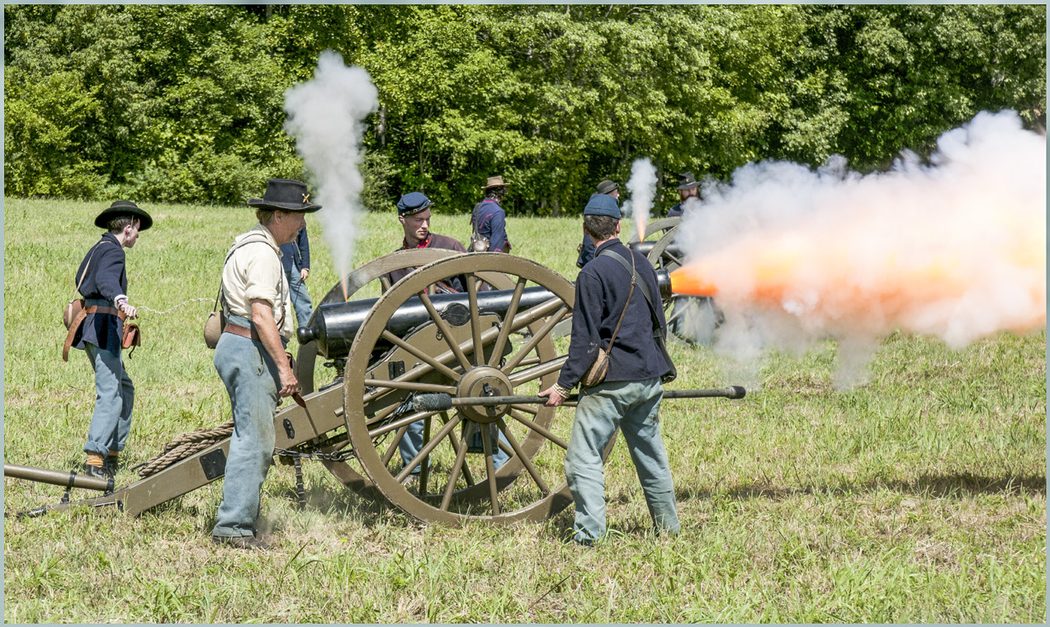
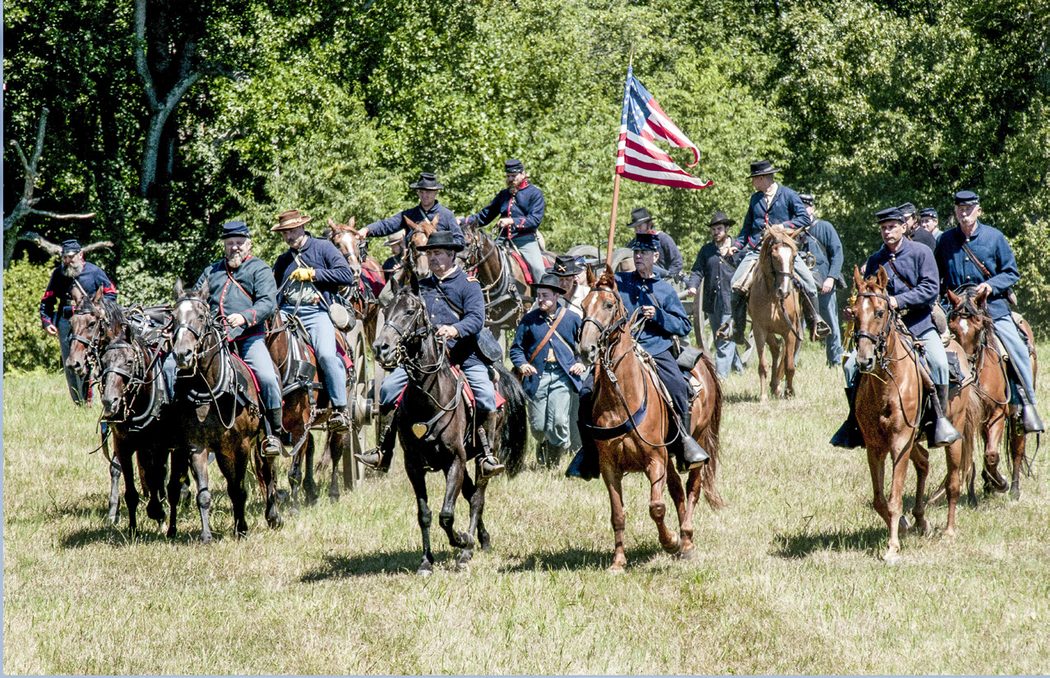
On August 9, 1862, Confederate General Jubal Early encountered cavalry and artillery forces of Union General Nathaniel Banks located on the plain above Cedar Run and near Cedar Mountain (also known as Slaughter’s Mountain). So, it was fitting that the living history event commemorating the Battle of Cedar Mountain featured an artillery duel.
Want To Advertise In Civil War News?
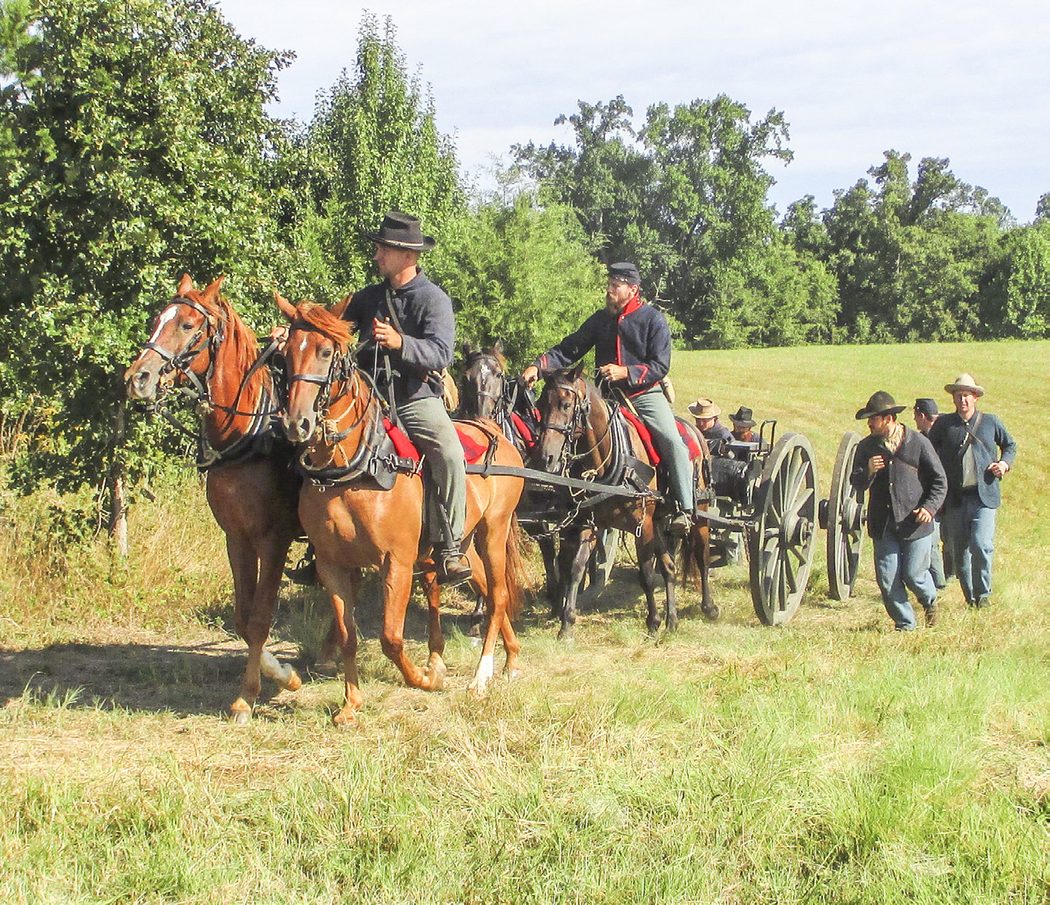
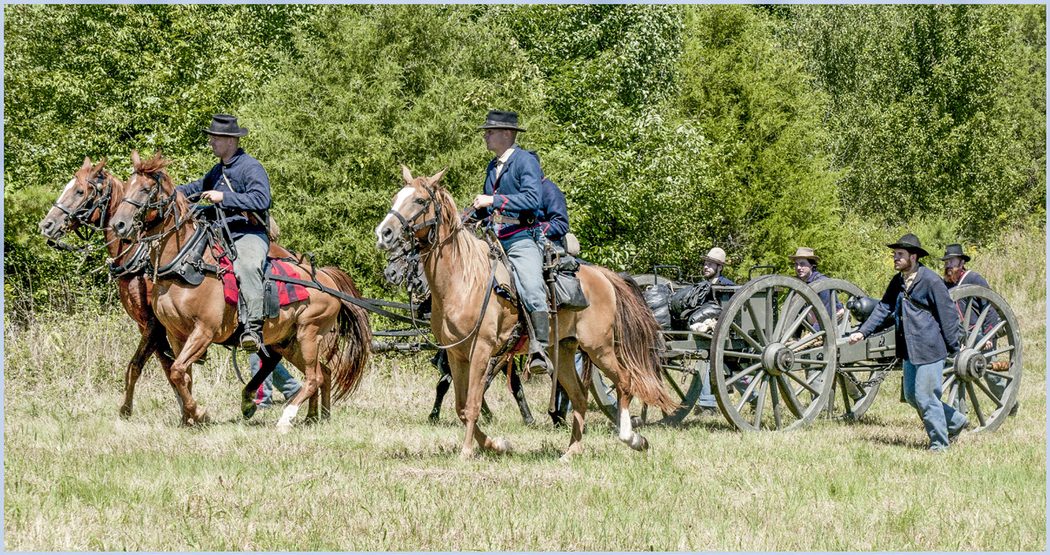
Confederate reenactors manned a brass Napoleon positioned near the location of the old Culpeper Turnpike (modern day Rt. 15). Union reenactors manned a section of horse artillery. Gun 1 was a Parrott rifle; Gun 2 was a 3-inch Ordnance rifle. A highlight of the day’s living history was the deployment of the two horse artillery pieces, with their accompanying limbers and teams of four horses each. The Confederate smoothbore gun barked out a challenge and was answered by the near simultaneous crash of the two Union rifled guns.
Those of you familiar with the area are aware of just how hot and humid it can be in August, but the reenactors and visitors to this year’s event were blessed with weather conditions that featured sunny skies, low humidity, and relatively temperatures that topped out in the low 80s.
If you have the opportunity, stop by next year and check out the battlefield. Once a place of terror and mayhem (Cedar Mountain was a relatively small battle but featured an extremely high casualty rate), the area is now a beautiful park preserved due to local efforts allied with the Civil War Trust.