I could not help thinking that there was a better way to deal with the Indians than to begin with the conquering sword and follow it up with starvation.
The Apache tribe is among the most famous of the warrior societies that peopled the Great Plains and Southwest. The names of two of their leaders—Cochise and Geronimo—are well known to nearly every American. The Apaches fought against white encroachment for as long as any Indians, with unsurpassed toughness and tenacity. By the 1870’s, they were armed with repeating rifles; they were extremely mobile; and, unlike many of the plains tribes, the Apaches did not count coup for bragging rights. They were interested only in results.
Two very different generals in the U.S. Army, both prominent in the Civil War, played important roles in the wars against the Apaches. In different ways both contributed to peace, though the calm was imperfect and shortlived, as was always the case in the nineteenth century.
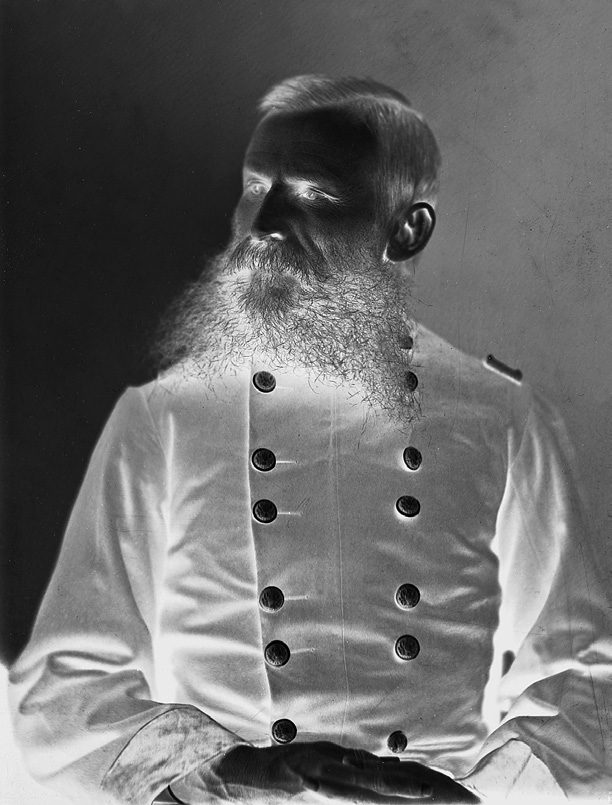
Oliver O. Howard ranked high in the West Point class of 1854. At the outset of the Civil War he left his teaching post at the academy to command a Maine regiment. He rose to the rank of brigadier general in the first months of the war. After losing an arm at Seven Pines, he returned to combat and divisional command. He was promoted to major general late in 1862. Howard led a corps at the Federal defeat at Chancellorsville and with more success at Gettysburg. Traveling west to fight in the Atlanta Campaign, he commanded the Army of the Tennessee after McPherson’s
death and led this force during Sherman’s march through Georgia and the Carolinas in the final months of the war.
Howard headed the Freedman’s Bureau after the war, but his work there was interrupted in 1872 when he was sent to Arizona to negotiate a peace treaty with the Indian tribes.
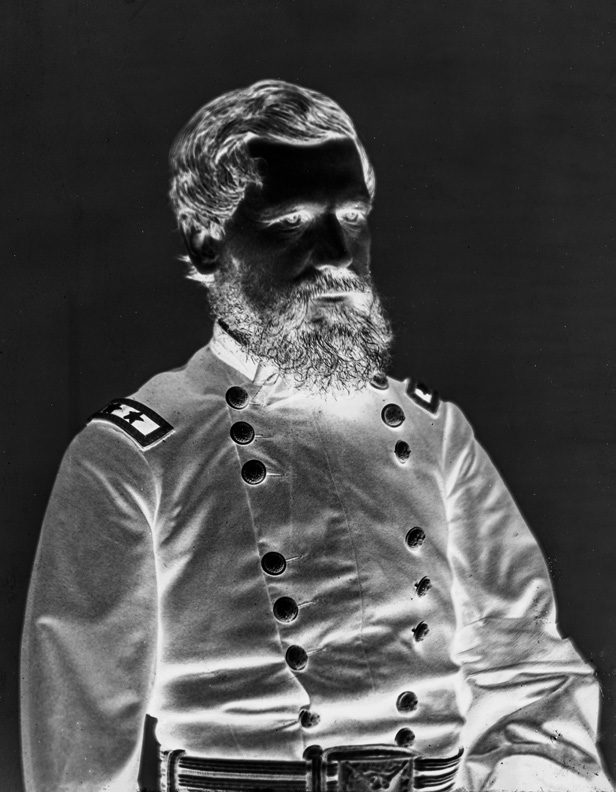
George Crook performed with less distinction at West Point than Howard, finishing toward the bottom in the class of 1852, but proved to be a capable officer in the Civil War. He began his service as colonel of an Ohio regiment. In 1862 he rose to the rank of brigadier general. He commanded a division at South Mountain and Sharpsburg and later led a cavalry division in the Western Theater. In 1864 he served effectively in East Tennessee and the Shenandoah Valley and was promoted to major general late that year. Captured in February 1865, he nearly sat out the rest of the war, but was exchanged in time to participate in the final campaign in Virginia.
Crook’s Civil War record was solid, but he is better known for his role in the Indian wars which followed.
In 1871, after his success against the Paiutes, Crook took over command of the remote Department of Arizona to run the war against the Apaches and other tribes. He was planning a relentless campaign to subdue the hostiles, but was made to stand down while the Federal government sent a commissioner to implement Grant’s Peace Policy, an effort to end the bloodshed by settling the Indians as farmers and stock raisers. After the first commissioner failed to achieve a stable peace, Crook was again preparing to gear up, but once more Washington decided to give peace a chance.
Howard had his hands full with the Freedmen’s Bureau, but when duty called he set out in March 1872 to seek peace with the Indians in Arizona. Would the famous Christian General succeed where the previous commissioner failed?
Crook was skeptical, but Howard entered into agreements with various tribes and subtribes and even took a delegation of Indians to Washington. When he and his charges returned to the west in the summer, he took on some unfinished business—making peace with the Chiricahua Apaches, a band not involved in the initial treaty.
Under Cochise the Chiricahua Apaches had fought a ten-year war against the U.S. from their stronghold in the Dragoon Mountains in southeast Arizona. In his autobiography, Crook wrote that he had spies in Cochise’s camp and was prepared to move against the band. Confident of victory, he was disappointed that intervention by Howard caused him to terminate his plan.
Oliver Howard was a man of great faith. He believed he had a mission to save the Indians as he believed he had a mission to save the freed slaves. Crook thought Howard naïve and his memoirs sometimes ridiculed the general, but it’s hard to argue with success.
Tom Jeffords, a former army scout who knew both the territory and Cochise, was recruited by Howard to take the general to the Chiricahua leader. Jeffords carefully picked guides and interpreters, and in addition was joined by a nephew of the chief. The party—which included no soldiers save Howard and two aides—set off from Cañada Alamosa in southwest New Mexico on a 300-mile trek across some of the roughest country in North America to reach Cochise’s stronghold.
Lookouts saw the expedition but, as it included Jeffords and Cochise’s nephew, the party was allowed to proceed. The Christian General and the Apache chief talked and quickly established mutual trust. Cochise was a realist. He had inflicted more losses on the whites than vice versa, but he knew that he could not last much longer in any war of attrition, as his band was reduced to a mere 400 and he himself was gravely ill.
After striking the deal with Cochise, which included a reservation for Cochise’s people in the Chiricahua Mountains, Howard journeyed to Fort Bowie to advise the army of the terms. Then, to seal the treaty, Howard and other officers traveled to a new, less remote camp established by Cochise. Howard wrote of his stay in this camp as Cochise’s honored guest. One night a celebratory dance held by his hosts. “When I was invited to dance I did so. As I passed into line an Indian woman held my left hand and another my empty right sleeve.”
Except for this agreement with Cochise, the treaties Howard made with Arizona’s Indians were not lasting. Some trouble on the White Mountain reservation ended in the death of a junior officer. Bands of Indians fled and began to attack white settlements. In September 1872 Crook’s hands were finally untied. This experienced leader understood his enemies and knew how best to fight them. He mounted well-equipped expeditions that were able to stay in the field for prolonged periods. He recruited Apaches and other Indians as scouts and (controversially) as soldiers. He engaged in continuous search and destroy missions, hunting the hostile Apaches down and wearing them out until they yielded. Crook’s memoirs record that “on the seventh day of April, 1873, the last of the Apaches surrendered.”
Crook’s campaigns, however, were not directed against Cochise’s Chiricahuas. The agreement with Cochise held. The settlers in Arizona were skeptical of Howard’s treaty and told him so. They felt that Cochise should be punished for his outrages and did not doubt that he would continue them, but as long as Cochise and his son and successor lived, the peace was honored.
In 1876 the Chiricahuas were forcibly removed to another reservation, one with other tribes and one on which they could not support themselves. Some stayed and suffered. Others, under Geronimo, rebelled. As Howard put it in his account, “An Indian war of the worst sort followed;” this war lasted a decade.
Following the peace with Cochise, Howard returned to
Civil War Antique Shop
Heller’s Antiques Buy and Sell Fine Antiques & Civil War Items
Washington and the Freedmen’s Bureau, where he stayed until 1874. Thereafter he fought in Indian wars in the Northwest and served as the superintendent of the Military Academy. He retired in 1894 and died in 1909.
After leaving Arizona in 1875 Crook continued to lead U.S. soldiers in the Indian wars, including a return to Arizona and an unsuccessful campaign against Geronimo. He died in Chicago in 1890 while he was in command of the Department of the Missouri.
Cochise did not live long after his treaty with Howard. He was a sick man when they first met and died in 1874.
Under Geronimo bands of Apaches resisted until 1886. After his capitulation, Geronimo was held as a prisoner in various army forts. In 1894 he was settled in Oklahoma, where he took up farming. The warrior-turned-cultivator died in 1929 at the age of 79.
Gould Hagler is the author of Georgia’s Confederate Monuments: In Honor of a Fallen Nation (Mercer University Press, 2014).
John Gregory Bourke, On the Border with Crook, 1891 Peter Cozzens, The Earth Is Weeping: The Epic Story of the Indian Wars for the American West, 2016 General George Crook, George Crook: His Autobiography, 2017 Patricia L. Faust, Editor, Historical Times Illustrated Encyclopedia of the Civil War, 1991 O.O. Howard, My Life and Experiences Among Our Hostile Indians, 1907.
Success in Spite of Ourselves
Two Against Lincoln: Reverdy Johnson and Horatio Seymour, Champions of the Loyal Opposition. By William C. Harris. Photographs, notes, bibliography, index, 272 pp., 2017, University Press of Kansas, www.kansaspress.ku.edu, $36.95 hardcover.
Reviewed by Richard J. Blumberg
In an unlikely alliance, a Maryland Senator, a New York Governor and the President of the United States achieved the preservation of the Union using different paths. Award-winning Lincoln historian William C. Harris explores how these men negotiated various political agendas in a manner not unlike what current politicians face today.
Reverdy Johnson, who enjoyed a personal relationship with President Lincoln, was one of only three men who served the U.S. Senate during both the Mexican-American War and the Civil War. Horatio Seymour, Governor of New York from 1863 to 1865, emerged as a Democratic leader espousing the old Jacksonian tenets and the original purpose of the war. Both Johnson and Seymour opposed Lincoln, but not in the way most Copperheads did.
Harris’ tome has four objectives: 1) provide readers with a better understanding of those like Johnson and Seymour who opposed Lincoln and the Republicans; 2) explain the political alignments and conflicts of Union states during the Civil War; 3) outline various political issues polarizing the nation and 4) describe Johnson’s and Seymour’s unsuccessful attempt to secure an immediate Southern restoration to the Union after the Civil War. The author uses an extensive collection of manuscripts and diaries to address his four themes.
Harris shows readers that midnineteenth century politics are not that different from today’s political arena. The Emancipation Proclamation, which shifted the Northern war aim from simply preserving the Union to ending slavery, is an excellent example of a heated issue where Johnson, Seymour and President Lincoln had to make concessions and compromises in order to achieve their desired goals. In the process, each held others accountable for their actions. In spite of themselves, these men accomplished their desired political aims.
This work is a comprehensive study of politics before, during and immediately after the Civil War. The author’s structure of two separate parts treating Seymour and Johnson creates a small obstacle in determining when these leaders agreed with each other while disagreeing with Lincoln. The end notes and essay on sources tend to mask the extensive research of primary source materials used in this study. However, neither of these weaknesses is significant compared to the information and fresh insight provided in this work.
Richard J. Blumberg has been a book reviewer for Civil War News for over 15 years. His article on hospital transports appeared in our Feb. issue.
Reviewed by Tracy J. Revels
Often a person of the past leaves only scattered footprints behind, enough of a trail to follow his life’s journey but not enough to truly understand his heart. Despite the impressive research and solid prose of his biographer, independent scholar Hank Trent, the Richmond slave trader Bacon Tait remains an enigma at the center of a biography which raises more questions than it answers.
Born near Lynchburg, Va., in 1796, as a young man Tait experimented with shop-keeping and real estate speculation before concluding that slave trading was the surest route to prosperity. Thanks to good luck and a sound partnership, Tait established a thriving business, running a prominent slave jail in Richmond’s Shockoe Bottom. But financial bounty came with a curse; slave traders were despised by virtually every stratum of southern society. No “respectable” woman would consider matrimony and Tait seemed destined to suffer permanent bachelorhood.
Around 1842, Tait met and began a sexual relationship with Courtney Fountain, a free black woman. The couple would eventually have four children. Fountain was part of an extended family and many of her relatives were active as abolitionists in Massachusetts. In 1852, Tait purchased a home in Salem, where he and Fountain lived as husband and wife, though he continued to spend part of each year in Richmond, conducting his traffic in enslaved people. This double life provides the book’s greatest mystery: how did Tait feel about Fountain, and how did she regard his career, which was based on the buying and selling of people like herself? To modern sensibilities, it seems an impossible relationship.
Trent excels in re-creating the world of antebellum fortunehunters like Tait. Lynchburg and the Richmond slave trade are diligently explored. A reader curious for more details as to how the trade worked (especially in terms of the operation of slave jails or “pens”) will find this small book an excellent resource. Trent makes it easy to imagine a grimy place of petty cruelties and vast injustices, where virtually every interaction possible within the boundaries of the peculiar institution might be found, all within a city block.
Though Tait unrepentantly made his living buying and selling people, Trent argues Tait was not a participant in the culture of sexual abuse. Trent finds no evidence that Fountain, who was a free woman, was in any way coerced into a relationship with Tait. Instead, Trent argues that Tait was a lonely man, isolated by his trade, who eventually found personal happiness and indulgent
Please send your book(s) for review to: CWN Book Review Editor, Stephen Davis 3670 Falling Leaf Lane, Cumming, GA 30041-2087
A STRONG BROTHERHOOD inBLOOD
by Brian L.J. Keator, Sr. Historically based fictional novel, commencing with one rural family’s experiences before centrally focusing upon a tight knit pack of classmates experiencing the battles of the Civil War
together. A true “you are there” experience. fatherhood by ignoring the racial prejudices of his age.
At its best, The Secret Life of Bacon Tait reminds readers of the great complexity of social life in the antebellum South. Variation existed, and for men like Tait, compromises were possible. While we gaze backward into the nineteenth century and see stark moral drama, for most people of the age life was banal and ordinary, filled with basic concerns of earning a living and establishing a family, in whatever form possible.
Trent’s book would benefit from some illustrations. While portraits of Tait and his family may not exist, images of slave jails or sketches of abolition meetings would enhance the narrative. A map of the slave trading district in Richmond would be especially helpful. In general, however, the writing is sound and the author is fair to his subject, making him neither a hero nor villain. Lacking more documentation, Trent cannot reveal the contradictions that Tait and Fountain surely must have felt, or explain why, at the end of his life, Tait made some rather shocking choices. Perhaps one day a packet of letters or more documentation will surface to answer the many questions that are left dangling at the end of the narrative.
Wrestling with His Angel. The Political Life of Abraham Lincoln, Volume II, 1849-1856. By Sidney Blumenthal. Timeline of major events, cast of major characters, photos, notes, bibliography, index, 581 pp., 2017. Simon & Schuster, www.SimonandSchuster.com. $35.
Reviewed by William D. Pederson
The author, a thoughtful political journalist who also has earned a national reputation as an eloquent writer, already has published more than a half dozen political books on Bush, Clinton, Reagan, and the Republican
Party, as well as a play. Sidney Blumenthal has now shifted his focus to Abraham Lincoln, with ambitious plans to complete a four-volume biography. This is the second in that quartet of volumes. The third volume is scheduled for release in 2018 and the final volume is scheduled for publication in 2019. Based on the first two volumes, Blumenthal is halfway through writing what promises to be the best multi-volume biography of America’s greatest president, who also is considered the greatest political leader in world history. Lincoln the frontier outsider who transformed himself into a statesman and became the touchstone of democratic leadership has found his biographer equal in Blumenthal.
The first volume, A Self-Made Man: The Political Life of Abraham Lincoln, 1809-1849, was published last year. It is simply the most readable and interesting biography about Lincoln from his birth through his single term as a congressman. A variation on the Horatio Alger “rags-to-riches” American dream saga, Lincoln’s story holds universal reader appeal. Lincoln finds his calling as a politician, but the neophyte politician is at best pedestrian early in his career. He approaches legislative life much like a latter-day frat boy eager for peer acceptance, understandable perhaps for the unpolished up-and-comer trying to fit into polite society. Then, unexpectedly, Lincoln meets his match in Mary Todd. Blumenthal unravels Lincoln’s first forty years in a page-turner, no small achievement when writing about the man who has been the subject of more books than any other democratic leader. The author gets Lincoln “right” through his meticulous research; Mary Todd similarly intuited the potential of her backwoods suitor.
Unlike the page-turner pace of the first volume, the tempo of the second volume is slow. It begins with a complex narrative skillfully interweaving a convergence of diverse historical threads. It thrusts the reader in the thorny labyrinth of slavery—the peculiar institution threatening the great American experiment in democracy—as the obscure local lawyer-politician contemplates how to free himself from the briar patch of slavery to achieve his audacious aspiration of becoming president of the United States. Volume II at the same time opens on a low note in Lincoln’s legal career, his failure in Todd Heirs (1849). The outcome of that case, brought to recover his wife’s rightful inheritance from her father, subtly underscores the pervasiveness of the slavery issue through the dramatic changes in Kentucky, Mary Todd’s home state, under pro-slavery extremists.
This context prevails for nearly two-thirds of Volume II. As the nation’s conflict heated up, John C. Calhoun, the foremost Southern intellectual, became tangled in his illogical “concurrent majority” that proposed two simultaneous majorities. Many lesser intellects favored violence to decide the conflict. Even Lincoln’s aging traditional hero, Henry Clay, became co-opted by two master manipulators—Jefferson Davis and Stephen Douglas, who soon eclipsed Calhoun and Clay. Sorting out the politics, Blumenthal demonstrates that Davis served as Franklin Pierce’s “acting president.” Davis actively worked to create a Southern empire in Latin America while the emerging Lincoln exposed Douglas’ sophistry.
And yet, when Blumenthal chronicles Lincoln’s emergence from “the most racist state in the North,” Illinois, the readability of the final one hundred pages of Volume II rivals Volume I.
Lincoln never traveled beyond the borders of the United States, unlike Douglas, but he was a student of human nature as well as an autodidact with an insatiable appetite for learning (even subscribing to British periodicals to broaden his knowledge base). Importantly, Lincoln could—and did—think for himself. As early as October 1854, Lincoln stated that justice (and morality) should have priority in democratic government. Blumenthal shows that Lincoln understood he could be bested in the courtroom, but also that he was more than a lawyer. Lincoln had formulated a moral vision for an open society.
The second volume concludes with America’s only published poet-president poised to become its first great “legislator” during the transition from a slave culture to an open one. It may evoke for readers Percy Shelley’s notion that poets are the real legislators of the world.
Readers now eagerly await release of the next volume in Blumenthal’s engaging series.
William D. Pederson holds the American Studies Endowed Chair at Louisiana State University in Shreveport and directs the university’s International Lincoln Center. Most recently, he delivered the May 2017 lecture on “Lincoln’s Legacy Abroad” for the Abraham Lincoln Group of Washington, D.C. The first in his dozen-part series on Lincoln stamps abroad appears in Americana Philatelic News, 2017.
Joseph Brown and his Civil War Ironclads: The USS Chillicothe, Indianola and Tuscumbia.By Myron J. Smith, Jr. Illustrations, maps, notes, bibliography, index, 396 pp., 2017. McFarland, www.mcfarlandpub.com, $39.95 paper.
This fact-filled and generously illustrated, comprehensive book focuses on a self-starter individual of immigrant parents, Joseph Brown. An early Alton, Ill., steamboating entrepreneur, Brown became a builder of gunboats for Grant’s critical Western river campaigns.
This is Myron Smith’s eighth book from McFarland Publishers relating to Civil War naval operations. It offers an in-depth look at the gearing up of the Union inland fleet, how the vessels were built, the assignment of vessel commanders, as well as army and naval rivalries both in the field and in Washington. All the while, Joseph Brown was able to forge ahead despite incredible challenges and setbacks.
Other chroniclers have noted that for the Union navy the Civil War had begun in an atmosphere of disorder; it remained to be
seen if Gideon Welles could bring order out of chaos. His greatest asset (together with a willingness to assemble a board of experts to advise him) was that he had an established navy and infrastructure to make the attempt. His Southern counterpart, Stephen Mallory, basically had neither. One more thing Welles had going for him was that Congress expanded the navy for the war as part of a general bill, and authorized the appointment of an assistant secretary of war, Gustavus Vasa Fox, Welles’ detail man.
As Smith acknowledges, naval vessel historian and exceptional blueprint artist David Meagher has greatly advanced our understanding of the sizes and layout of Brown’s USS Chillicothe, Indianola and huge Tuscumbia ironclads. The book covers thoroughly the rise of Joseph Brown in political and business circles with assistance from his older brother (who had become politically connected). Chapters chart the familiar expeditions of the substantial and growing Union fleet, including conditions encountered by ship and crewmen during their long, hard slogs of service. Rather than describe examples here, readers will be better left to considerable hours of digesting this exemplary book.