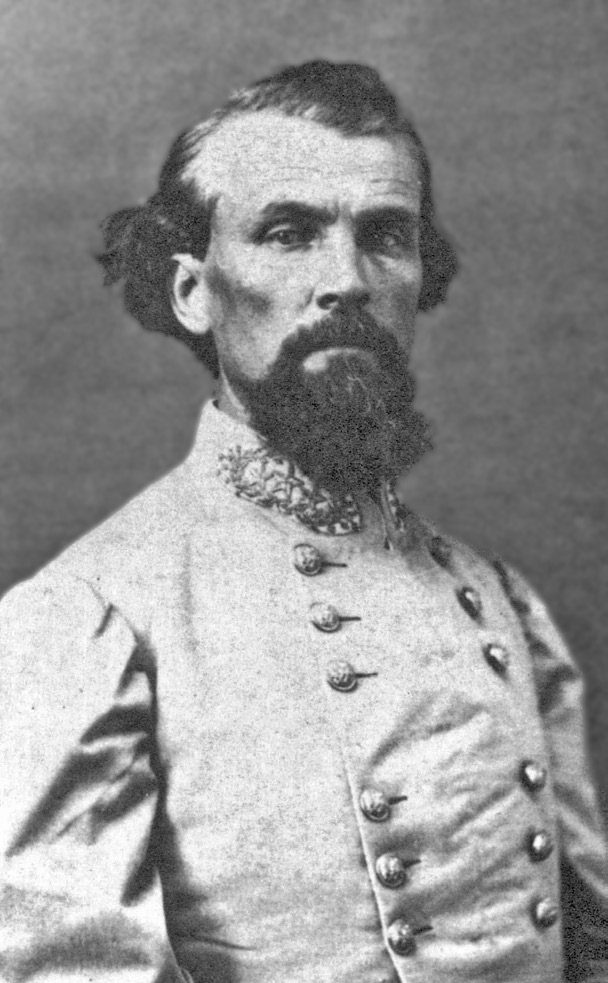
Some years ago a dedicated group of preservationists in Tennessee, “Raise the Gunboats, Inc.”, retrieved a collection of artifacts from the Tennessee River 30 miles above Paducah, Ky. Found by a dredging operator who alerted state archaeologists, they came from remains of the Union gunboat Undine 55, a Union vessel significant for its capture by Nathan Bedford Forrest. Forrest then turned the boat around and engaged in a naval battle with a small convoy from which it had been separated by a bend in the river. The daring maneuver earned Forrest the rank of ‘Admiral’ by his cavalry “crew.” A court of inquiry followed for the vessel’s Acting Master who spoke more candidly than would be likely today.
Forrest and cavalry commander Joe Wheeler had been wreaking mayhem in the region for a couple of years in their attempts to disrupt Union supply lines. On Oct. 30, 1864, about 30 miles above Paducah, Ky., Forrest and his gunners spied a lone enemy gunboat and saw an opportunity in the making though he would modify his plan from destruction to one of disabling, repairing, and launching the gunboat into Confederate service unbeknownst to the other Federal transports.
Artillery quickly got the Undine in its sights and, after an hour of sparring, a cannonball shattered the exhaust pipe, another smashed the furnace, and four more blasted through the casemate. Another round cracked a steam pipe, the scalding mist forcing the engineer from the engine room.
Acting Master John L. Bryant attempted to surrender his boat now “entirely unmanageable” and, after hastily spiking the guns, headed toward the river’s east bank where he and surviving crewmen scrambled into the woods and trekked to Union held Fort Donelson. Meanwhile two transports that “jumped into the tempest” were so battered by Southern shellfire from Forrest’s judicious placement of artillery they were beyond being of assistance.
Summarizing a long story that involved a previous calamity to the stricken ship in a previous life that nearly sunk her, now Forrest would took the 180-ton warship to Paris Landing for quick repairs to turn his new “flagship” against its previous operators or lure them within range of sharpshooters. He also planned on using Undine to carry detachments of cavalry to raid the Union Johnsonville supply base and then haul supplies to Lt. Gen. John Bell Hood’s army at Tuscumbia, Ala.
The vessel with her eight 24-pounder howitzers disabled was rearmed with two 20-pounder Parrott rifles captured from one of the transports. Soon more Federal ships would descend upon the Undine as it lay at anchor, under Cobb’s Ky. Btry. officer and an old experienced steamboat captain, who thus relieved Forrest of his naval commission. Undine met its demise after a barrel of oil was poured over some shredded mattresses and set ablaze. But not before, supposedly, a cargo of fine brandy for a general and more importantly, the captain’s signal code book were confiscated.
Forrest then proceeded onward on Nov. 4, 1864, to the destruction of the Johnsonville supply depot. On Nov. 6, Sherman telegraphed Grant, “That devil Forrest was down about Johnsonville making havoc among the gunboats and transports.” Sherman was correct, By Nov. 10, it was said Forrest had destroyed or captured 4 gunboats, 14 transports, 20 barges, and a large quantity of stores. Some six to eight million dollars was the estimated tab for Johnsonville alone.
On Nov. 7, 1864, a military court of inquiry was convened at Mound City, Ill., “to ascertain and report all the facts connected with the loss of the U.S.S. Undine, in Tennessee River.” The embarrassing loss of the signal codes to Forrest’s troopers-turned watermen was conceded although Bryant was absolved of fault and justified in his decision to abandon his gunboat when “opened on by rebel artillery and infantry fire” and “again opened on by a battery of four or five field pieces crossing their fire from different points.” The tribunal held the vessel well-fought and creditable discipline maintained throughout with proper actions taken that had been “occasioned by the attack of a superior force.” Perhaps it could be added also by a bolder force?
Acting Master Bryant recounted, most candidly it appears, what happened Oct. 30, 1864:
“When abreast of Paris Landing I was hailed by a man on the bank, ‘Halloo there gunboat’ or some such words. I immediately stopped my engines. At that instant was opened on from the west bank by a heavy artillery and infantry fire about 50 yards from shore. I returned their fire and immediately headed the ship for the batteries and fought them for 55 minutes up to 700 yards distance, where I had my escape pipe shot off. A shot passed in through my furnace and knocked the fire out.
“I then got out of range of the upper battery, under the west point of the river, in order to repair my damages and to warn the transports that might come down from Johnsonville. I had not been anchored over 10 minutes when I was again opened upon by a heavy fire of musketry from the west bank which was immediately returned from our broadside guns.”
“At 3:10 the enemy opened with a crossfire of artillery and musketry...and I used at that time canister, the range not being over 100 yards, which apparently had good effect among the enemy concealed in the bushes on the banks. At 3:45 the main steam pipe in the doctor room was cracked and filled the place with steam, and drove the engineer from his station. I headed her for the east bank to save as many of the crew as possible. At 4 o’clock, knowing that I could not get off from the enemy, I struck my flag, which the enemy did not respect, but kept up an incessant fire upon me. I fired my broadside guns, ordered all the guns spiked and the ship fired, knowing I had fought as long as I could. I ordered the men to save themselves. At this moment I was knocked senseless and when I came to I got on shore and followed after the crew.”
While another brilliant move by Forrest, the sacking the Johnsonville depot came too late to have a larger impact on war in the Western theater. By November 1864, Sherman had already amassed enough stores and ammunition in the Atlanta area that Johnsonville no longer of crucial importance.
Digital Issues of
GEORGIA’S CONFEDERATE MONUMENTS In Honor of a Fallen Nation Gould B. Hagler, Jr.
This unique work contains a complete photographic record of Georgia’s memorials to the Confederacy, a full transcription of the words engraved upon them, and carefully-researched information about the monuments and the organizations which built them. These works of art and their eloquent nation’s profound grief, praise the soldiers’ bravery and patriotism, and pay homage to the cause for which they fought.
In Sept. 1864 a grand jury of the United States Circuit Court sitting in Memphis, declared that Nathan Bedford Forrest was a traitor against the United States, “wickedly devising and intending the peace and tranquility of the United states of America... engaged in a warlike manner, that is to say with guns, swords, pistols and other warlike weapons.”
A year later the Chief Justice of the Supreme Court, Salmon P. Chase, directed the marshal of the District of West Tennessee to “take the body of Nathan B. Forrest...[and] have him before the Judge of the Circuit Court of the United States...to answer the United States on a Bill of Presentment against him for Treason.”
Forrest was never arrested and tried for treason. The marshal of the United states District Court simply wrote that “Defendant not to be found in my district.” (National Archives and Records Adminis tration (NARA)
In the October 2017 issue of Civil War Times is an article titled “Empty Pedestals. What Should Be Done With Civic Monuments To The Confederacy And Its Leaders?” by Dana B. Shoaf, Editor. Fifteen prominent Civil War historians, who are on the magazine’s advisory board, wrote interesting and thoughtful opinions on the controversial Confederate monument removals. Here are a few of their comments.
“Many want the museum to take a firm stand to support or oppose the removal of these items from the public landscape… When it comes to the American Civil War, the answer is not always “blue and gray. Americans of every background grapple with the war’s legacies in contemporary times. This history is not dead or past. This history is present.”
“Removing statues in New Orleans and elsewhere is unfortunate, however understandable…“Lost Cause” mythology claims that Confederates seceded over self-determination. Ironically, as local populations today reevaluate who to memorialize, that argument is ascendant.”
Gary W. Gallagher, John L. Nau III Professor of History, Director, John L. Nau III Center for Civil War History University of Virginia
“Debates about the Civil War’s memorial landscape erupt periodically and usually feature the same arguments from those who want to leave statues and other monuments in place and those who want to remove them… Taking down statues, in contrast, potentially inhibits a real understanding of our past, warts and all, and can obscure important themes, movements, and eras.”
His was, for a time, the only unit west Wilderness Church that was actively resisting the Confederate onslaught. Dilger volunteered to hold his position while scattered elements of several Union regiments coalesced into the Buschbeck line behind him.
Firing single, and then double, canister at extremely close rang
“It is my opinion, and that of many others, that these removals are an attempt to erase history.”
Harold Holzer, The Jonathan F. Fanton Director of Hunter College’s Roosevelt House Public Policy Institute, and Vice Chairman, The Lincoln Forum
“In effect, I remain torn. I abhor the iconoclastic destruction of art—whether by the Taliban at Bamiyan, Afghanistan [where two monumental sculptures of Buddha were blown up in 2001] or by our own justifiably offended citizens in New Orleans. Using the preservation of a mediocre Jefferson Davis statue to rally neo-Nazis waving the Stars and Bars is a repugnant exercise that deserves condemnation.”
In the July issue of CWN, subscriber’s comments were requested about the controversy concerning removal of Confederate statues and monuments. I do not think these statues and monuments should be removed. The campaign to do so is aligned with a movement to revise and sanitize history. This is what happens in totalitarian nations. Hitler and Stalin were experts in rewriting history to further their own nefarious ends. Good history tells all, the good and the bad, warts and all. If these statues and monuments are removed, where will all this end? Next we will have to take down statues of George Washington because he owned slaves and made war on Indian people, didn’t he?
Andrew Jackson forcibly removed native tribes from the southeastern states so the land would be open to white settlement. Those tribes were at peace with the U.S. government. This resulted in the “Trail of Tears.” Hundreds lost their lives in that forced move to Oklahoma. Robert E. Lee was a gentleman and
es, the shock of Dilger’s battery bought the Buschbeck line 20 minutes needed to organize a desperate defense, before the Georgians closed in for hand to hand combat with the gunners. Dilger finally gave the order to withdraw, miraculously only losing one gun as the Confederates demanded surrender. It was then that Dilger’s horse was mortally wounded, pinning him underneath, directly in the path of the rapidly advancing Confederates. In an act of extreme bravery Dilger’s orderly, a a good man. What does that matter, drag him through the dirt too. President Polk engineered the war with Mexico. Was this not a blatant land grab? Get rid of him, adios. Look what Sherman did in Georgia. Why don’t the people in Georgia raise enough hell and get him out?
The point I am trying to make is we could wind up removing just about all American historical figures for one reason or another. I am originally from Indiana and have ancestors who fought for the Union so I cannot be called a Confederate apologist. We are embarking onto a dangerous slippery slope just to appease the politically correct. If this comes to pass, one day we will wake up in a nation we do not know.
The future of interest and caring for our American Civil War rests on connections to communities as a whole.
We, elders who have collected, studied and written of the war, should accept that the lives of younger men and women are focused on health, employment, climate and a way of life working with all races and lifestyles.
Battle flags and monuments should be looked at in ways that are about the “other” person. Consider what is needed to preserve individual beliefs and service—then make it work for us all.
Henry Deeks Ashburnham, Mass.
“If I had my druthers,” I would let all Confederate statues remain, because I am strongly interested in Civil War history, and, perhaps, also because I am a collateral descendant of a Confederate soldier. With that said, statues on public property may be legally removed, as was the case in New Orleans. Disappointments, protests, and letters may not prevent the removals. Whether the reason for removal of a statue
small boy named Ackley, noticing that Dilger had been left behind, took it upon himself to ride directly in front of the Confederates to search for him. After finding his Captain, both managed to ride back to relative safety behind the soon to be broken Buschbeck Line at Dowdall’s Tavern where Dilger continued the fight.
Dilger’s splendid efforts and heroism would ultimately lead to a Medal of Honor in 1893, to which he responded, “It is highly gratifying to me, as an is claimed to be for diversity, or due to changing demographics in large cities, the statues might be removed.
It will be more difficult to remove any statues or monuments on State property, and particularly on Federal property, such as on NPS battlefields, but at some point in the future it could happen. In the meantime, people can study Confederate history and biographies and put up portraits of Davis, Lee, or other favorite Generals in their homes. Hopefully, this will never be forbidden, and the books and prints seized and burned.
Leon Basile Woburn, Mass.
Removing Confederate monuments under the gun of political correctness is a bad idea for two reasons.
First, the history of the South’s evolving society becomes more apparent by adding new shrines to honor more recent heroes than by destroying old ones. Both will remain as tangible evidence to future generations of how our history evolved. Moreover, the South has been doing this for decades, but getting no credit for it.
Despite anger among the politically correct over their state flag, for example, Mississippi towns have seventeen streets named in honor of Martin Luther King Jr. Maine, Vermont, New Hampshire, and Rhode Island have none. Minnesota and Iowa have one each, while Massachusetts and Connecticut have two each. Pennsylvania has three.
The second reason to retain Confederate monuments is that almost nobody today realizes the magnitude of the losses endured by Southern families and their descendants. About six percent of the region’s white population died as soldiers. If America went to war today with comparable losses, the number of people in uniform killed would be over eighteen million, or three times the number of Jewish Holocaust
old professional soldier, to have my services…even after a lapse of 30 years, at last officially appreciated and thus handsomely rewarded.”
It is CVBT’s honor to finally ensure that the land so closely associated with Captain Dilger’s heroic actions is faithfully preserved. Since the Kinney tract was already zoned as a commercial district and sits at a high volume intersection, one can only imagine what might have been otherwise.
Given such losses, nobody should wonder why Confederate families wanted to honor the loved and lost. To the contrary, I’d wager $100 against a good Cuban cigar that today’s average American would think something would have been wrong with them if they didn’t.
I have been a reader for 10 years and thought the Civil War News could not get any better, but thankfully I was wrong. It is now my favorite Civil War “magazine”.
Thank you for soliciting opinions on the removal of Civil War monuments.
Unfortunately, in the last eight years our country has slipped further to the Left. Our society has become so polarized that everything is Black or White and there is no area for discussion. In Mayor Landrieu”s press release he says “ I am not judging people”. Really? Does he really believe that the rewriting of Civil War history is better for the people and really what we want?
Recently the NAACP has demanded that the State of Arizona remove all 10 of it’s memorials to the Civil War. Without taking sides in the issue I have advised all of my 418 members to write and call the Governor’s office and voice their opinion.
I wondered if the Civil War Trust had advised their 58,000 members to write the socialist mayor of New Orleans it would have made a difference. I doubt it. The Mayor seems to know what is best for the country.
Since George Washington and Thomas Jefferson were slave owners, do you believe the people will stand by while Mount Vernon and Monticello are burned to be politically correct?
I think it is time that we all take a proactive part and let the politicians know where we stand on this issue.
John Bamberl Scottsdale Az.
Since the acquisition, CVBT has set to work restoring the area to its historical appearance. This included removing a nonhistorical condemned structure that was in partial collapse. This all comes at a cost of course, and CVBT has recently begun soliciting donations from members to offset the $144,000 price tag for such an important purchase.
Whereas, there is now pending the case of the Missouri Civil War Museum v. the City of St. Louis, Cause No. 1722-CCl 0277 (“Lawsuit”), in the Circuit Court of the City of St. Louis, and
Whereas, the parties desire to resolve the issue of the ownership and disposition of the Confederate Monument currently located in Forest Park (hereinafter “the Monument”), and
Whereas, the City of St. Louis (“City”) intends to permanently remove and relocate the Monument from Forest Park, and
Whereas, the Missouri Civil War Museum, United Daughters of Division, and the St. Louis Confederate Monument Association have all asserted claims of ownership of the Monument, and
Whereas, the Missouri Civil War Museum, United Daughters of Division and the St. Louis Confederate Monument Association agree to certain stipulations concerning the final disposition of the Monument.
Wherefore, the parties agree as follows: 1. The Missouri Civil War Mu
2. The Missouri Civil War Mu
MONTGOMERY COUNTY, Md.—July 22
“I am pleased to announce today that the County is relocating the Confederate soldier statue from County property next to Rockville’s Red Brick Courthouse to a private location overlooking the Potomac River at White’s Ferry. This location is near the river crossings actually used by Confederate forces during the War Between the States. The County the Confederacy-Missouri
seum shall remove the Monument, in its entirety, from its current location in Forest Park no later than June 30, 2017. The City will ensure that the Missouri Civil War Museum and its contractor, Heitkamp Masonry, Inc., have access to the Monument as necessary to dismantle and remove the Monument from Forest Park. Additionally, the City will provide the Missouri Civil War Museum and its contractor access to the cap or “crown” of the Monument that was previously removed and permit the Civil War Museum to remove it as well.
seum agrees to bear all costs associated with dismantling the Monument, transporting it out of Forest Park and storing the Monument subsequent to its removal. The 3. The Missouri Civil War Mu
4. The Missouri Civil War Mu
5. The United Daughters of
On the Moving of Montgomery County’s Confederate Statue
recently transferred ownership of the statue, given to us by the United Daughters of the Confederacy in 1913, to White’s Ferry, Inc.
“My motivation in wanting the statue moved is simple and straightforward.”
“Montgomery County residents fought on both sides of the tragic conflict that so divided our nation more than 150 years ago. I agree with President Obama, who said City acknowledges that removing the Monument may cause some minor damage to the Monument site and the ground immediately adjacent to the site. Neither the Missouri Civil War Museum nor its contractor shall be responsible for the anticipated and normal wear and tear or damages associated with removing the Monument from the site.
seum, United Daughters of the Confederacy-Missouri Division, and the St. Louis Confederate Monument Association each agree that after the Monument is removed from Fore st Park, it will not be placed or publicly displayed in the City of St. Louis or St. Louis County at any time in the future.
seum, United Daughters of the Confederacy-Missouri Division, and the St. Louis Confederate Monument Association each agree that any future placement and display of the Monument will be limited to the following locations: a Civil War Museum, Civil War battlefield, or Civil War cemetery. Prior to the Monument being placed at any of those locations, the Missouri Civil War Museum will first advise the Office of the Mayor of the City in writing, with copies provided to the City Counselor, no less than five days prior, of the location of its intended placement so that the City may confirm that the placement is consistent with the terms of this Settlement Agreement. the Confederacy-Missouri Division and the St. Louis Confederate Monument Association each attest, agree and covenant that they have conveyed any and all ownership they might have in the Monument to the Missouri Civil War Museum.
Statement by County Executive Ike Leggett
6. The Missouri Civil War Mu
7. The Missouri Civil War Mu
8. The Missouri Civil War Mu
9. The Missouri Civil War
10. If removal of the Monument
that understanding the history of the Confederacy and the history of the Civil War is something that every American should be part of.
“However, this statue is inaccurate because it pays tribute only to the Montgomery County young men who fought for the Confederacy, not also to those County residents who fought to preserve the Union and free those held in bondage.
“Therefore the statue does not seum warrants, covenants and agrees that if it ever voluntarily relinquishes its possession, control or custody of the Monument to a third party, said third party shall be bound by the terms and conditions of this Settlement Agreement.
seum agrees to indemnify and hold harmless the City for any damages it may incur as the result of the City’s compliance with the terms of this Settlement Agreement, including but not limited to any third party claims asserting any type of ownership interest in the Monument.
seum, United Daughters of the Confederacy-Missouri Division and the St. Louis Confederate Monument Association do each, for themselves and their respective executors, administrators, successors in interest and assigns, hereby release and forever discharge the City of St. Louis, its agents, servants and employees, from any and all claims, demands, actions, or causes of action that they now have, or may hereafter have, in any way related to the ownership or disposition of the Monument, including but not limited to claims asserted, or which could have been asserted, in the Lawsuit. Museum, United Daughters of the Confederacy-Missouri Division and the St. Louis Confederate Monument Association shall dismiss the Lawsuit with prejudice immediately after removal of the Monument is complete and confirmed by the City’s Director of Parks, Recreation & Forestry or by July 6, 2017 at 9 a.m., whichever occurs first. The parties agree to bear their own costs and attorneys’ fees.
represent a balanced view of our County’s sacrifice during the Civil War. I believe it should not be located on County property. Because it has significance locally, I want it to remain in
Montgomery County – but not on County-owned land. I wanted it to be accessible to those who want to visit it.
“Like most Americans, I do not believe in ‘erasing’ past history to conform to what might be is complete and confirmed by the City’s Director of Parks, Recreation & Forestry no later than July 6, 2017 at 9 a.m., the City consents to the release and return of the bond posted with the Court by the Missouri Civil War Museum in conjunction with the temporary restraining order previously issued in the Lawsuit. If the Missouri Civil War Museum fails to complete the removal of the Monument prior to July 6, 2017 at 9 a.m., the City shall be entitled to complete the removal of the Monument, retain any portions of the Monument that the City removes, and recover against the aforementioned bond posted by plaintiff in the Lawsuit to reimburse the City for expenses incurred in such removal. In such case, the City shall also be entitled to pursue claims for any Monument removal expenses that exceed the amount of the ten-thousand dollar ($10,000) bond posted in the Lawsuit.
as provided in paragraph 11 above, the City 12. The waiver and release terms
13. This Settlement Agreement
Attorney for Plaintiffs Missouri Civil Daughters of the ConfederacyMissouri Division and the St. Louis Confederate Monument Association.
presently prevailing politics. As President George W. Bush said at the dedication ceremony for the National Museum of African American History & Culture, ‘A great nation does not hide its history. It faces its flaws and corrects them.’ I believe that this relocation is consistent with those sentiments.”
hereby waives and releases any and all claims, causes of action and/or demands which it may have against the Missouri Civil War Museum, United Daughters of the Confederacy - Missouri Division and the St. Louis Confederate Monument Association related to the claims asserted in the Lawsuit.
contained in this Settlement Agreement shall not be construed lo prevent the parties from enforcing the terms of this Settlement Agreement. represents a compromise of disputed claims, and the considerations set forth herein, including the mutual promises and agreement, are not to be construed as an admission of liability on the part of anyone.