“I don’t believe we can have an army without music.” – Robert E. Lee
Just south of Nashville, the City of LaVergne, Tenn., celebrated a milestone anniversary last month. Originally incorporated in 1860, the city reincorporated in 1972 and offered festivities in honor of the 45th anniversary of that event. It may as well have been a 150th anniversary because the programs had a distinct 1860s feel to them. To begin with, the city of LaVergne asked the nearby Stones River National Battlefield Park in Murfreesboro, Tenn. To provide a historic weapons program, specifically a Civil War musket firing demonstration.
As a long-time volunteer at Stones River, I offered to present the program. This is not only because I enjoy doing these presentations, but also because we live in a time when many municipalities are removing any reminders of their involvement in the Civil War, LaVergne seems to be doing the opposite. They are actively celebrating their proximity to battles that occurred in the area during late 1862. The Mayor of LaVergne, Dennis Waldron, is quick to point to historical markers on US Highway 41 commemorating Civil War events right in front of the park where the programs are held. They include “Major General
Joseph Wheeler’s Ride around Rosecrans” (Dec. 30, 1862) and another marker commemorating local citizens involved in the war effort. There were also nearby skirmishes when the left wing of Rosecrans’ Army of Cumberland came through the area on Dec. 26, 1862.Hence, in my case even though it meant doing three battlefield park events on three consecutive weekends, that alone is enough of a reason to make the LaVergne anniversary program a “must do.”
The historic musket firing demonstration was the standard “load in nine times” program. It ends with an attempt to recreate the expected “three shots per minute” rate of fire for a Civil War infantryman. Someone in the crowd with a watch offered to track the time and, if memory serves, I was able to duplicate the feat in just under a minute, although just barely (59.6 seconds). Let me hasten to add that unlike what an actual Civil War soldier experienced, nobody was firing back at me. After the demonstration, the crowd lingered with some questions about the program, which is normal. This time people dissipated more quickly, and the reason for that quickly became apparent.
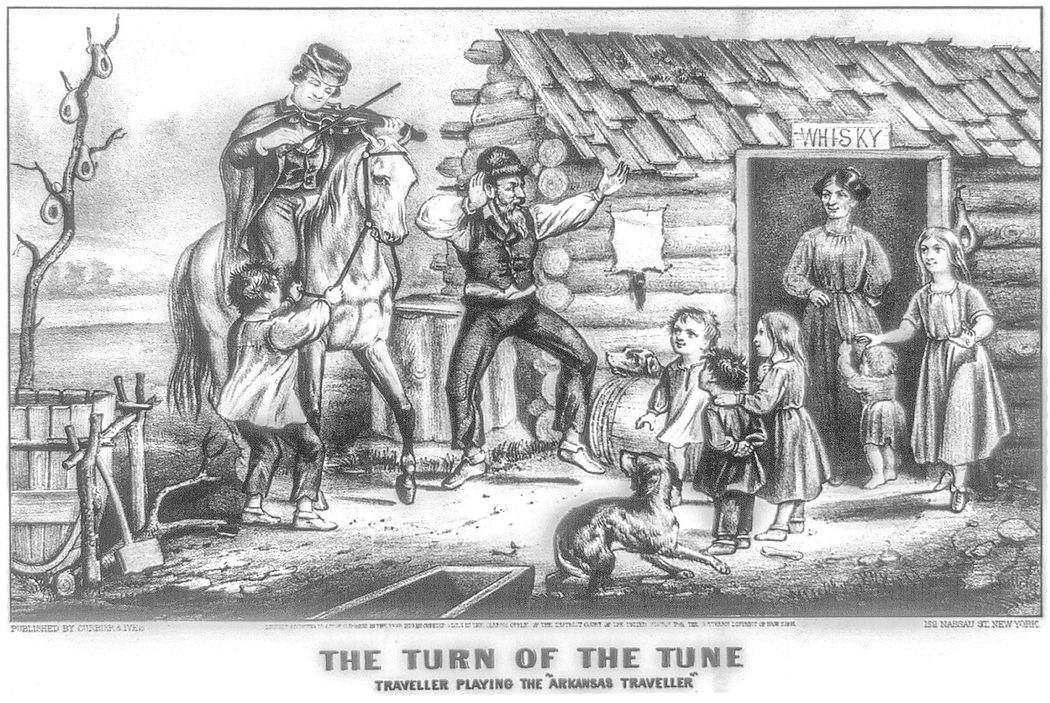
As I was cleaning my musket, the sound of a violin playing “St. Anne’s Reel” became audible. Upon further investigation, and to my delight, the city had arranged for an “old timey” music program. The band played “Arkansas Traveler,” followed by “The Year of Jubilo (Kingdom Coming),” the old fiddle tune “Soldiers Joy” (it’s not what you think,…the song is about morphine addiction), “Aura Lea,” “Battle Cry of Freedom,” and finally, “Ashokan Farewell.” That particular song is not of the Civil War time period, but once Ken Burns included it in his 1990 Civil War documentary, it might as well have been. There is nothing contemporary sounding about “Ashokan Farewell,” which is composed in the traditional style of a slow waltz or a Scottish lament. It is played twenty-five times during the course of the documentary’s eleven hours of. For that reason, most listeners closely associate it with the Civil War-era. All in all, those lucky enough to be in attendance were treated to about twenty “old timey” songs.
There was also a “buck dancing” performance to the period musical accompaniment by Thomas Maupin. So what exactly is “buck dancing”?
According to Margaret Binnicker of Middle Tennessee State University, “buck dancing” is a traditional form of percussive dancing that originated in the Southern Appalachian region. It was brought to the area by Scottish and Irish settlers in the 18th century. It works well with “old timey” music, such as songs from the Civil War-era. It is something like “clogging,” except that it is performed solo whereas cloggers are usually in a group.
The band was called “Home Sweet Home,” an American string band consisting of a violinist or fiddle player (Elaine Winters), and a banjo player (Daniel Rothwell). According to Winters, the violin and the fiddle are the same instrument, with the difference being how the instrument is played, or the type of music being played. The banjo played by Rothwell was the period’s correct open back variety played in the claw-hammer style. It sounded very distinct from the steel stringed, fretted bluegrass banjo with the large resonator plate. There was also a guitar/dulcimer player (Rob Pearcy) in the group, but he was absent from that particular performance. Professional musicians of this caliber are in high demand during the summer months. The players in the band are all award winners and Winters serves as a judge for fiddle events in the region.
In the theatrical film, “Oh Brother, Where Art Thou” (2000), the rival politician Homer Stokes levels a stern accusation at the Soggy Bottom Boys when he says to the crowd, “Hell, they ain’t even old timey.” So what is meant by the term “old timey” in reference to music exactly? It is not limited to the Civil Warera or the Appalachian region of the Southern states, although it is mostly associated with that time and that region. Similar music was played in all parts of America in the 18th and 19th centuries. Many songs that we closely associate with the Civil War period are based on traditional folk songs, including reels and jigs, some of which can be traced back to European sources while others are completely of American origin. When the writing credits of a song are credited as “Traditional” it usually means the author, if there was only one, is not known or can’t be determined. Many “old timey” songs certainly fall into this category. Others were just written in that style. In a way modern bluegrass music evolved directly from this traditional country folk music. So “old timey” is a categorization or grouping of traditional country folk music before the term “bluegrass” came into usage during the 1920s.
“Old timey” music originated with, and is meant to be played, on acoustic stringed instruments. Historically the violin was the common leading instrument and, for all intents and purposes, much of the music heard by Civil War soldiers was courtesy of the violin and banjo. These songs had the right feel to them. John Billings noted in “Hardtack & Coffee: The Unwritten Story of Army Life,” published in 1889, “There was probably not one regiment in the service that did not boast at least one violinist, one banjoist... one or both of them could be heard in operation, either inside or in a company street, most any pleasant evening....The usual medley of comic songs comprised the greater part of the entertainment, and, if the space admitted, a jig or clog was stepped out on a hard tack box or other crude platform.” Lastly, many songs in the “old timey” music genre are played at a surprisingly fast tempo. Civil War soldiers enjoyed upbeat music they could dance to, or that at least would lift their spirits and for a while take their mind off the hardships of camp life.
That is exactly the kind of program that on hand with the band “Home Sweet Home” at the recent anniversary program in LaVergne, Tenn. It is a throwback to a date and time before recordings, when music was played live and the “hits” of the time were in the form of sheet music. As Robert E. Lee put it, “I don’t believe we can have an army without music.”
Craig L Barry was born in Charlottesville, Va. He holds his BA and Masters degrees from the University of North Carolina (Charlotte). Craig served The Watchdog Civil War Quarterly as Associate Editor and Editor from 2003-2017. The Watchdog published both books and columns on the material culture of the mid-19th century and donated all funds from publications to battlefield preservation.