Black Powder, White Smoke
A War Shotgun, Postwar Rifle Muskets & Submarines
Muzzleloading double-barreled shotguns were in use early in the Civil War by some cavalrymen, particularly Confederates, but were usually replaced when carbines or Enfield rifles became available. At least one was used effectively in a long forgotten episode during the latter part of the war, however. Those who have seen the recent movie The Free State of Jones no doubt noted that the protagonist, Newton Knight, who deserted from the Confederate Army and led a secession against the secessionists in Jones County, Mississippi, carried a double barreled shotgun.
Knight’s ability to rapidly load and fire his muzzle loading double gun (probably with premade paper cartridges) was locally legendary, and although the original gun, which Knight nicknamed “Sal,” has not survived, the filmmakers turned to Pedersoli to provide an authentic reproduction of a typical shotgun of the era. The full story of the reproduction shotgun used in the film, including an impressive shooting test with buckshot, is told in an article in Shooting Times magazine, available here: http://
Established 1981
Life Member, Company of Military Historians International Society of Appraisers Life Member, NC Division, SCV Federal Firearms Licensed Dealer
Contrary to what some might think, Springfield rifle muskets were not discarded to the scrap heap following the Civil War. The New Jersey National Guard carried them as their basic arms through 1875, when they were finally replaced by .45-70 Springfield breech loaders, and rifle muskets were retained in the state armory until the turn of the century. They endured in some official capacity in other government agencies in various states well into the postwar era.
On November 9, 1887, the Chicago Police Department received fifty 12-gauge Model 1887 Winchester shotguns and 2,500 rounds of ammunition. An article in the Chicago Daily Tribune announcing the delivery also commented on the guns, already in the city’s police arsenal, that were being replaced by the Winchesters. Perhaps surprisingly, those arms turned out to be Civil War Springfield rifle muskets. Characterized as “old but quite serviceable.”
The reporter who conveyed the news that rifle muskets were still at least theoretically in service in the Chicago police department spent some time on a mostly accurate essay informing the no doubt surprised public how these obsolete arms were loaded and fired. Quoting General Winfield Scott as saying “rapidity of loading and discharging firearms is of doubtful advantage in actual service, as soldiers are apt to discharge their pieces without proper aim, and thus waste ammunition.”
The reporter went on to say that the police still had “a few hundred rounds” of .58 caliber rifle musket ammunition on hand, and had actually tested it recently, along with some Civil War Era Sharps carbine linen cartridges, (there were also some Sharps in the police arsenal) and they shot as well as when they were new. He concluded by writing, not quite accurately to be kind, that some of the old soldiers prefer these muzzle-loading muskets to the repeating rifle guns. The former can be loaded and fired two or three times a minute. The latter can belch forth fifty-four bullets in three seconds.” Our New Book
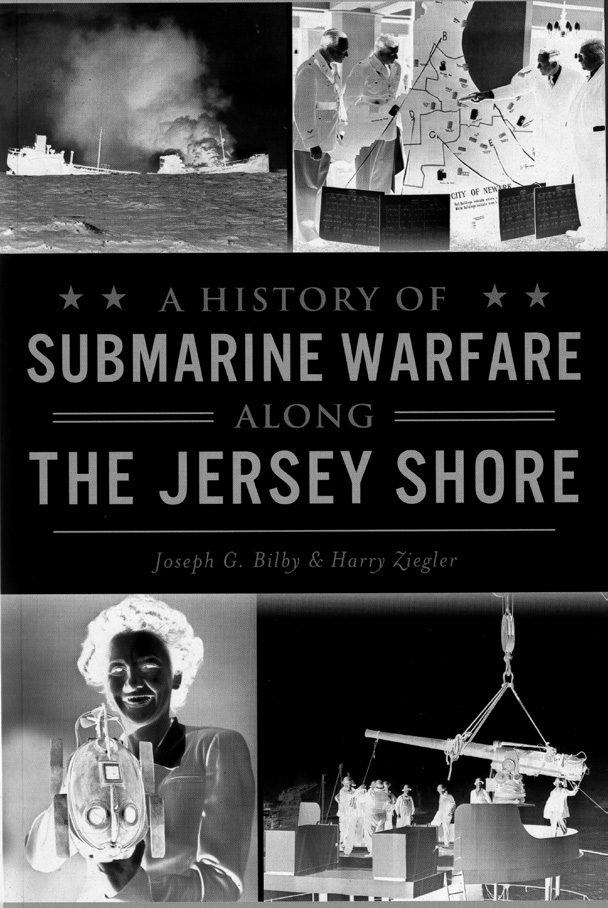
Not strictly black powder, but a little, I hope, pardonable, self-promotion. New Jersey has a long history with submarines. The first American submarine, David Bushnell’s Turtle, which failed in its attempt to sink a British vessel near Manhattan, met its end in 1776 when the ship it was being transported to New Jersey on went to the bottom of the Hudson River off Fort Lee. The “Intelligent Whale,” the only surviving Union Civil War submarine, which was sponsored by New Jersey investors,
History, Competition & Camaraderie and largely built in Newark was tested by the Navy in the summer of 1864 and owned by New Jerseyan Oliver Halsted, sits in the National Guard Militia Museum of New Jersey in Sea Girt.
The first successful submarine adopted by the United States Navy was invented by Paterson Irish immigrant John Holland, who tested his prototype undersea boats in the Passaic River and the Hudson River on the Jersey City waterfront. His final model, the first modern submarine accepted by the Navy, was built in Elizabeth.
The state’s largely benign relationship with submarines turned sour in 1918, however, when the German Navy’s U-151 went on a one-day six-ship sinking rampage off the New Jersey coast. Worse was yet to come. A World War II U-Boat offensive, nicknamed by German submariners as “The Happy Time,” torpedoed numerous ships off New Jersey in 1942, leaving oil soaked beaches strewn with wreckage and an occasional body as state government and the military struggled with a response – and each other. That coastal conflict has left an echoing narrative that resonates dimly down to the present day.
My co-author Harry Ziegler and I decided to tell the little known and long forgotten story, more comprehensively than it has been before, and the result was our book Submarine War Along the Jersey Shore (The History Press, 2016), which was published in August. The fully footnoted book is illustrated with over 70 photographs, many not seen for over seventy years. It is available in your local bookstore, Amazon, or autographed from the authors.